
Shawn Gaston, 22, was convicted of first-degree murder in the death of Officer Alejandro “Alex” Valadez on June 1, 2009. Jurors reached their verdict late Wednesday evening, just a few hours after beginning their deliberations, following a weeklong trial. Chicago Police Officer Alejandro Valadez (Credit: CPD) Valadez was 27 years old when he was shot to death in 2009. He had been on the force for only three years and was working undercover duty on the South Side on June 1, 2009, investigating reports of gunfire when Gaston allegedly gunned him down on the 6000 block of South Hermitage Avenue
Tuesday, 4 October 2011
Cook County jury has convicted a 22-year-old reputed gang member of killing a Chicago police officer two years ago.


Friday, 23 September 2011
Dowler lawyer pursues US legal action against News Corp
The solicitor who represented the family of Milly Dowler in their phone-hacking claims against News Corporation on Friday announced he has teamed up with US lawyers with a view to initiating proceedings targetting Rupert Murdoch and his son James. Mark Lewis of Taylor Hampton has instructed Norman Siegel, a New York-based lawyer who represents 20 9/11 families to seek witness statements from News Corp and directors including the Murdochs in relation to allegations that News of the World staff may have bribed police. He says he intends to assess whether he can launch a class action against News Corp using American foreign corruption laws, which make it illegal for US companies to pay bribes to government officials abroad. "There is a provision within US law, before you start an action to seek depositions from individuals, in this case, such as James Murdoch and Rupert Murdoch and other directors of News Corp," said Lewis. He added Siegel would examine allegations of not just police bribery but also phone hacking and "foreign malpractices." The move will be a fresh setback for News Corp which has been trying to insulate itself against contagion from the UK phone-hacking scandal that has engulfed its British publishing empire. Separately, it emerged that this week US prosecutors at the Department of Justice have written to Murdoch's News Corporation requesting information on alleged payments made to the British police by the News of the World. The DoJ is looking into whether the company may have violated the Foreign Corrupt Practices Act (FCPA). Under FCPA laws, American companies are banned from paying representatives of a foreign government to gain a commercial advantage. The decision to co-ordinate legal efforts on both sides of the Atlantic comes just days after News International confirmed it was in settlement talks with the parents of the murdered 13-year-old schoolgirl. News International is discussing a total package of around £3m including a personal donation from Rupert Murdoch of £1m to a charity of the Dowler's choice. News Corp declined to comment but it is understood that senior executives question whether there is any basis for Lewis's actions.
Wednesday, 21 September 2011
Authorities confirmed Monday were captured Saul Solis Solis, aka El Lince, one of the main leaders of the group of Knights Templar.
The action was carried out by the Mexican Army. The Lynx, is a cousin of Henry Plancarte Solis, also leader of the Knights Templar. The Attorney General's Office offered a reward of up to 15 millions of dollars for information leading to his capture. The action was achieved in the town of Mujica, in the municipality of Nueva Italia, Michoacán. In the raid also arrested Mario Alberto Gallardo Rodríguez, alias El Mayo, and a young child.
Gunmen halt traffic, dump 35 bodies on busy downtown avenue in Gulf coast city in Mexico

Sunday, 18 September 2011
Gangland boss Carl Williams fingers cop Paul Dale from beyond grave
ON April 24, 2007, deep inside the razor wire of Victoria's Barwon Prison, gangland killer Carl Williams finally decided to tell his story about crooked cops and Melbourne's underworld war. Williams is now dead, but his lurid tale echoed from the grave yesterday as his version of history, made in three statements over two years, was read out to a spellbound audience in the Victorian Supreme Court trial of Williams's alleged murderer, Matthew Charles Johnson. Johnson has pleaded not guilty on the basis of self-defence. According to Williams's statements, his relationship with former policeman Paul Dale began nervously. The gangland killer and the policeman were so "paranoid" about each other that they once met in a swimming pool wearing only bathers so that neither could be "wired" with listening devices. But the court heard the dealings between this odd couple would blossom into something far more deadly. Before long, what began as merely secret payments for information escalated to a murder, sanctioned and paid for by Dale, Williams alleged. The tone of the gangland killer's statements are as casual as they are cold. When Williams heard that the hitman he hired at Dale's request to kill police informer Terrence Hodson had also killed his wife, Christine, he asked the gunman: "What happened with the sheila?" "That's not for you to worry about," the gunman replied, about which Williams said, "That was the end of the conversation". According to Williams, he met Dale following his release from prison in 2002 when Dale requested a meeting with him via another criminal. "I first met him at the Brunswick Club, where Lewis Moran was killed," Williams said. "He (Dale) was telling me he could keep an eye out for me. "In return, Dale expected to be paid for any information that he gave to me . . . I think we were both suspicious of each other at that time and remained so." Williams said, early on, Dale showed him a police report that revealed that an Asian man called Jimmy had been giving information to the police about Williams, who was called "Fat Boy" in the police report. "As a result of reading the report, I dropped off Jimmy and did no more (drug-dealing) business with him." The court heard that Williams's relationship with Dale grew as they met more often. "On most occasions when I met with Dale, I would give him an envelope with money in it. The money I paid Dale usually ranged from $2000 to $5000 each time." On one occasion, he said, Dale asked him if he wanted the detective to do anything to Williams's gangland rival Jason Moran. "It was pretty widely known that Jason and I had problems at the time," Williams said in his statement. "I didn't know whether they (Dale and a fellow detective) were fair dinkum or trying to set me up. Dale said he could kill Jason for $400,000. I told them they were dreaming." Williams claimed that Dale told him he had arranged internal police systems so Victoria Police would be unable to check on Williams without Dale knowing about it. "He told me he did this so that he could keep up to date with any investigations against me." At one stage, Williams said, Dale asked him to meet in a swimming pool near Seaford where Dale told Williams to tip off fellow gangland figure Tony Mokbel about a police investigation into a drug laboratory. "We met at the swimming pool because he was paranoid of me and I was paranoid of him," said Williams. "Dale had two pairs of shorts or swimming togs. We put these on and got into the pool and walked up and down in the water." The court heard that in his April 2007 statement, Williams said he had no knowledge of who killed the Hodsons at their Kew home in May 2004, but in his second statement, in January 2009, he was ready to reveal the hitman. "I didn't want to be a dog and be a protection prisoner, but my attitude has changed," he said. Williams alleged that Dale told him he had to "get" Hodson before he could give evidence at a committal hearing about his alleged involvement in a burglary involving drugs, in which Dale was implicated. He said: "We went for a walk. Dale told me that he had to get Hodson and he had to get Hodson before Dale's committal. "Dale said he didn't want to go back to jail. He said he had been in isolation and it was tough. "He said he had someone on the job but it was taking too long to get Hodson. Dale asked me if I could help him out." Williams claimed Dale told him the job would pay $150,000. Williams said he approached a hitman who he knew had "a reputation as a fairly ruthless bloke". He met with the hitman, who can't be named for legal reasons, on the ground floor of the Marriott hotel. "I told him there was a contract there for Terry Hodson and I told him the amount of $150,000. There was never any contract on his wife and I never mentioned Terry's wife to (the hitman)." Williams said he didn't know exactly when Hodson would be murdered and the first he heard about it was on the news. The court heard that a few days after the Hodsons' deaths, Williams's statement said, he got a call from Dale telling him "it's been dropped off". "I knew he was talking about the money for the Hodson murders," Williams said. "I was at my mum's when Dale made that call to me. I went and checked the bin. It was a large green wheelie bin that Mum kept inside the gate. Inside the bin, I saw a plastic bag and I took it out of the bin and went back inside." He said he counted the money, which was bundled in $10,000 amounts with rubber bands around it. "It might have been $100 or so short but effectively the money was all there." A few days later, Williams met the hitman at the Marriott again. "I left the bag containing the $150,000 on the ground next to our seats and he collected it." "(The hitman said) 'Quick, hey?' and smiled and chuckled. "I said to him: 'What happened with the sheila?' He said: 'That's not for you to worry about.' That was the end of the conversation. "I asked him about the sheila because I didn't think she needed to die and she wasn't a part of the contract. Having said that, I didn't push it any further." Williams said he never spoke again to the hitman about the Hodson murders. "It is an unspoken rule that once a job is done, you don't mention it again so you don't get caught out on a listening device or something." He also revealed that hitmen preferred to kill on cold days because "the cold weather means it's less likely that people will be out walking around and possibly witness something". In his January 2009 statement, Williams said "since I have been locked up, (lawyer Nicola) Gobbo has told me that Dale has asked after me and has asked if there is anything he can do for me. I just dismissed it because there was nothing he can do for me and I don't want to deal with him." Williams was bashed to death in Barwon jail in April last year.
Saturday, 17 September 2011
11 of the 54 prisoners in Menorca jail are British
11 of the 54 prisoners being held in prison on Menorca are British, according to the prison authorities, who says their presence on the island is dependent on the air connections to the UK, which allows family visits to the inmates. The same sources, quoted by Menorca.info, say that none of the Britons have a ‘conflictive’ profile. The jail on the Carretera de Sant Lluís also currently holds 23 prisoners who are of Menorcan origin or who have links to the island. Another 20 are being held ahead of their appearance in court.
Brazil judge's murder points to vigilante power
Judge Patricia Acioli was known for wielding a "heavy hammer," especially against rogue police who have formed illegal vigilante gangs. She had put more than 60 officers behind bars, most of them for murder. The Rio de Janeiro state judge paid for that fearlessness: Acioli was shot to death in front of her house last month. And all of the 21 bullets that hit her came from a lot issued to police, including some in Sao Goncalo, the city where she worked. While violence and impunity are common in Brazil, the brazen murder of Acioli was an especially heavy blow, a message of intimidation from the vigilante militias. The slaying was "a wound to the lawful state, to democracy; the figure of the judge is a symbol of justice," said Denise Frossard, a retired judge who presided over some of Rio's first cases against the militias in the 1990s. "If she is a judge and can be killed, how can a citizen feel secure enough to be a witness?" Acioli's death was the first murder of a judge in the state's history, though Frossard herself survived three assassination attempts and had eight security guards ensuring her safety while she was on the bench. Violent militias have grown in power and scope in recent years, taking over poor communities formerly controlled by drug dealers and coercing residents to pay for illegal utility hookups, transportation, and security. Their members include former and current police, firefighters and jail guards. Investigators say they have elected members as state and city legislators. They also have been praised by politicians, including Rio de Janeiro's mayor, for taking back swaths of territory from drug gangs. A probe by the state legislature in 2008 found militias were connected to execution-style killings, far-reaching extortion schemes, and the kidnapping and torture of a group of journalists investigating the gangs' activities. Acioli had been repeatedly threatened for taking on the police officers who were part of the gangs, and she had written letters to her superiors requesting protection. One week before her murder, she went to Rio police's internal affairs office and said she was being threatened by officers from Sao Goncalo, where she worked, and Niteroi, where she lived. The last case on her docket on Aug. 11, the day she died, involved policemen charged with executing an 18-year-old man in a slum. One of her last acts as a judge was to authorize their arrest. A month later, three of the same Sao Goncalo police officers were charged with her murder. The suspects knew the judge would ask for their arrest, and wanted to stop her, said Felipe Ettore, the head of Rio's homicide division, in a press conference this week. They didn't know she'd already issued the order. "Their way of stopping her was to kill her," Ettore said. "They went to court and followed Patricia to her front door." Nationwide, the lives of 134 judges are currently under threat, according to the National Council for Justice, which oversees the judiciary branch in Brazil. Requests for protection from magistrates jumped 400 percent in the month since Acioli's death, according to the Brazilian Association of Judges. The killing prompted the United Nations special rapporteur on the independence of judges and lawyers, Gabriela Knaul, to urge Brazilian authorities to protect those charged with enforcing the law. "The assassination of Judge Acioli is evidence of the existence of a pervasive and serious problem regarding the protection of judges in Brazil," said Knaul, a Brazilian judge herself. Acioli's caseload was taken on by three other judges. Seven prosecutors are now working with them. "Her death did bring on a fear among prosecutors and judges; they're human, and it's natural to think, 'That could be me tomorrow,'" said Claudio Lopes, Rio state's attorney general. "But if this was done to intimidate justice, it is backfiring. We will be more rigorous than ever." The work is not only dangerous, it's difficult. Militias infiltrate the state from local police departments to state legislatures. They have a particularly nefarious effect on the legal system because they blur the boundaries between legitimate agents of the law and criminals, Lopes said. "They're often composed of people credentialed by the state to promote public safety, and they turn against the state, against the public," he said. "They usurp the authority of the state. In this way, they are a danger that goes deeper than drug traffickers." Even a few years ago, some politicians still praised militias for doing what the state couldn't do: take on drug dealers entrenched in the city's shantytowns. Former Rio Mayor Cesar Maia welcomed them as a "lesser evil" and a form of "community self-defense" against drug gangs, according to the newspaper O Globo in 2006. Current Mayor Eduardo Paes praised militias in a July 2008 interview on Globo television, saying they "brought peace to the population" in areas where the state had lost sovereignty to drug lords. Such views are changing as the body count rises. The 2008 investigation led by Marcelo Freixo, head of the state legislature's human rights commission, led to the arrest of one state representative and six city council members for militia activity. Hundreds were arrested on other charges because of information detailed in the report. One of those arrested, Rio City Councilman Luiz Andre Ferreira da Silva, is accused of plotting to kill the city's police chief and Freixo. In Sao Goncalo, 34 officers were put on leave after Acioli's death because they face serious criminal charges such as murder, according to Rio state's Supreme Court. Arrest warrants have been issued for 28 of them. In spite of the threats to Acioli, court officials had cut her security detail from four to one in 2007, said Tecio Lins e Silva, an attorney representing her family. "This is a matter involving my life, and it is very important," Acioli wrote in a letter appealing the decision. "I don't understand the treatment being given to the case." But the security officers were not reinstated. At the moment she was shot, no one was there to protect her.
Friday, 16 September 2011
Exeter crack cocaine and heroin gang jailed
Exeter Crown Court was told the LYNC gang boasted of being able to supply drugs in Exeter "all day, every day". The gang used a park at Cowick Barton in the city as its centre of operations. Two men from Greater Manchester - Kevin Newton, 30, and Billy Downing, 22 - were jailed for nine and five-and-a-half years respectively. Three of the gang were from Dawlish in Devon. James Brooks, 32, and 27-year-old John Rowntree were both sentenced to five years, while 22-year-old John Bullock was jailed for 30 months. Cannabis jail supply Lloyd Simpson, 44, from Exeter, was sentenced to six years. James Prince, 22, from Huddersfield was sentenced to 30 months and 28-year-old Anthony McStein, from Liverpool, was jailed for four years. The gang were arrested after being monitored by police between October 2010 and March this year. The eight ringleaders were jailed for a total of nearly 40 years The force said information provided by local residents had been critical in bringing the "highly organised" gang to justice. The drug dealers brought the heroin and crack cocaine into Devon on a regular basis from Manchester. The court heard that not only did the gang boast about its ability to supply drugs, it also sent mobile phone text messages to addicts advertising when new supplies had arrived in the city. Police said the gang's "utter disregard" for local communities and the welfare of the addicts they supplied "beggared belief". Continue reading the main story “ Start Quote We don't want drugs in Exeter” Insp Jacqui Hawley Devon and Cornwall Police The force praised local residents who worked with officers to provide information on the crimes, in order to "reclaim" their local playing fields. "This is the core bedrock of local policing, working with the community, working with our partners in order to resolve an issue," Insp Jacqui Hawley said. "We don't want drugs in Exeter. We want it to be a safe place and in the main it is." A man and a woman were also sentenced at Exeter Crown Court for conspiring to supply cannabis to Brooks while he was on remand at HMP Exeter. His 30-year-old wife, Donna was jailed for six months, while Blair Murray, 29, from Tyne and Wear, was sentenced to 12 months.
West Malling drugs gang sentenced
gang of four drug dealers have been jailed for conspiring to supply illegal drugs across Kent. Brothers Joseph and Samuel King, Craig Provan and Matthew Newin controlled dealing in towns across Kent from a travellers' site in West Malling. Joseph King, 48, was jailed for 18 years and Samuel King, 47, for seven-and-a-half years at Canterbury Crown Court. Provan, 41, was sentenced to six years, and Newin, 26, to eight years. Joseph King, of Lavender Road, West Malling, and Provan, of The Paddock, Highsted Valley, Rodmersham, were found guilty of conspiracy to supply drugs. King was also convicted of possessing firearms with intent and for possession of criminal property. His brother, of Elm Grove, Sittingbourne, and Newin, of Swanstree Avenue, Sittingbourne, pleaded guilty to conspiracy to supply drugs. Undercover operation During the seven-week trial, the jury had to be given basic lessons in a 16th Century Romany dialect called Rokker, which was used by two of the gang. They were caught after the travellers' site next to Hoath Woods was infiltrated by undercover police officers. Thousands of pounds worth of heroin, cocaine and ecstasy were exchanged during more than a dozen transactions between June and September last year. The court heard the gang controlled street dealing in a number of towns across Kent and had a particular hold in the Canterbury and Sittingbourne areas.
Thursday, 15 September 2011
Three bailed over murder of ex-gangster Dave Courtney's stepson Genson Courtney
THREE men have been released on bail over the murder of Genson Courtney in Greenwich. Police found Mr Courtney suffering from gunshot wounds in a black Volkswagen Golf at around 10.50pm on July 3 in Banning Street. The 23-year-old, stepson of ex-gangster Dave Courtney, was taken by ambulance to hospital but was pronounced dead at 3.43am. A post-mortem gave the cause of death as gunshot wounds to the head. Three men, aged 28, 34 and 27, who were arrested at addresses in east and south London on suspicion of murder, have been released on bail to return on November 8. Detective Chief Inspector Mark Gower from the Met’s Trident unit is still appealing for witnesses. He said: “I am appealing to anyone who may have seen or heard anything suspicious to contact the police. "I would like to reassure anyone concerned about contacting the police that Trident has great expertise in protecting witnesses and there are a huge variety of measures that can be put in place to protect you."
Monday, 12 September 2011
Madeleine Cops In Portugal
They may not have welcomed the order from Downing Street to launch an investigation into Madeleine McCann's disappearance, but at least Scotland Yard detectives have made a first visit to Portugual. I can't imagine they were given a warm welcome by their Portuguese colleagues whose work (failure to solve the mystery) the Met team is reviewing. Still, it's a step in the right direction and officially the two groups met "with very good co-operation and liaison will continue." There are 30 Met officers - the equivalent of a murder squad - working on the review and I'm told that a senior officer is having to give regular spending updates to the Home Office which is funding an operation that will cost several millions and last many months. It's four months since the review was launched with great fanfare by the Prime Minister after a plea from Kate and Gerry McCann. The couple had long felt abandoned by the British and Portuguese authorities to hunt alone for their missing daughter. But it's difficult to get much information about the operation from the cops, No 10 or the Home Office. A recent Freedom of Information request for answers to a dozen of so questions has been held up by the Yard's FOI man while he considers if the info sought is in the public interest.
Assault weapon used in Palmetto nightclub shooting

Sunday, 11 September 2011
Microsoft online services hit by major failure
Millions of Microsoft users were left unable to access some online services overnight because of a major service failure. Hotmail, Office 365 and Skydrive were among the services affected. Microsoft was still analysing the cause of the problem on Friday morning, but said it appeared to be related to the internet's DNS address system. Such a major problem is likely to raise questions about the reliability of cloud computing versus local storage. Especially embarrassing is the temporary loss of Office 365, the company's alternative to Google's suite of online apps. Its service also went offline briefly in mid-August, less than two months after it launched. The latest disruption is believed to have lasted for around two-and-a-half hours, between 0300 GMT and 0530 GMT. In a blog, posted at 0649 GMT, Microsoft said: "We have completed propagating our DNS configuration changes around the world, and have restored service for most customers." The Domain Name System (DNS) is responsible for translating URL web addresses , such as bbc.co.uk into the internet's native system of IP addresses, e.g. 212.58.246.95.
Dramatic new phone hacking twist as police quiz top Guardian writer
A Guardian newspaper reporter has been questioned under caution by detectives investigating phone-hacking at the News of the World. Amelia Hill, who has broken major scoops about the scandal engulfing the Murdoch media empire, was quizzed by police probing alleged leaks from the investigation into News International. It is understood the 37-year-old reporter had a friendship with a detective who works on Operation Weeting. A Scotland Yard officer has been arrested and suspended on suspicion of leaking information to the Guardian. It marks an extraordinary twist in the five-year saga that has led to the arrest of 16 people, including Prime Minister David Cameron's spin doctor Andy Coulson, and the resignation of NI chief executive Rebekah Brooks. A Guardian News & Media spokesman said: "We can confirm Amelia Hill has been questioned in connection with an investigation into alleged leaks. On a broader point, journalists would no doubt be concerned if the police sought to criminalise conversations between off-record sources and reporters." In July Hill broke the Guardian's Milly Dowler story - described as a "tipping point" in the scandal - which revealed that private investigators working for the NoW hacked the voicemails of the murdered schoolgirl after she went missing. Within weeks, Mrs Brooks, Metropolitan Police Commissioner Sir Paul Stephenson and Les Hinton, media mogul Rupert Murdoch's right-hand man for more than 50 years, had all resigned. It is understood Hill received police tip-offs about impending arrests. The Evening Standard has been told the police officer suspended from Operation Weeting called the Guardian the night he was arrested asking to speak to Hill. The Guardian has broken key scoops relating to the scandal which began when former NoW royal editor Clive Goodman was jailed for hacking the voicemails of royal aides in 2006. In July 2009, the newspaper also revealed NI had paid £700,000 to football union boss Gordon Taylor in a bid to cover up alleged widespread phone-hacking at the now-defunct Sunday tabloid. Dan Roberts, the Guardian's national news editor, said on Twitter that the developments were a "bleak day for journalism when (a) reporter behind vital hacking revelations is criminalised for doing her job". Two separate internal inquiries into police relationships with the media were launched after it emerged that the NoW had allegedly paid more than £100,000 to corrupt royal protection officers in return for information. An inquiry by Her Majesty's Inspectorate of Constabulary is examining "alleged corruption and abuse of power" in police relationships with the media. Separately, former Parliamentary Commissioner for Standards Elizabeth Filkin is drawing up a framework for how police officers handle their relationships with reporters. Three years ago, a case against Sally Murrer, a reporter on the Milton Keynes Citizen, and a former Thames Valley police detective Mark Kearney was thrown out. Kearney had been accused of leaking information to her. Meanwhile, police arrested another 35-year-old man at his home at 5.55am on suspicion of conspiracy to intercept voicemail messages. He was taken to a north London police station for questioning. He is the 16th suspect to be held since the scandal broke. The dawn raid came as it emerged that Mr Coulson is refusing to give evidence to the House of Commons committee investigating the scandal. MPs on the culture, media and sport select committee have asked him to comment on claims that he knew that hacking was widespread on the NoW when he was editor
Thursday, 4 August 2011
Five members of an elite police gun crime unit have been sacked for "inappropriate behaviour".
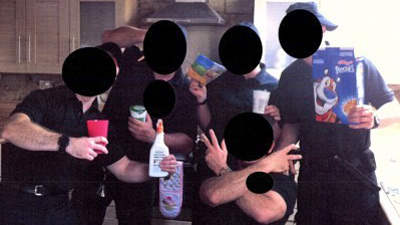
The photo was discovered during a professional standards investigation
An investigation into their conduct led to the discovery of a photograph which appeared to show the officers fooling around during a raid on a suspect's home.
The group were dismissed after being found guilty of gross misconduct.
All five constables worked within Merseyside Police's Matrix team which targets drug-related gang and gun crime in the region.
A sergeant who was part of the unit was fired in May as a result of the inquiry.
The sergeant and two constables are currently on police bail amid allegations that items removed during police searches appeared on eBay.
Deputy Chief Constable Bernard Lawson said: "We expect the highest standards from our officers and these officers fell far short of that expectation.
"As a force we believe it is important to take swift and decisive action when officers are found to have fallen short of the standards we expect and in this case we have done just that."
The Matrix unit helped target the gangs associated with the murder of schoolboy Rhys Jones who was shot dead in Croxteth in August 2007
Monday, 18 July 2011
London mayor says relationship between John Yates and Neil Wallis raises questions but refuses to be drawn on whether David Cameron should resign
London mayor Boris Johnson has refused to be drawn on whether David Cameron should resign over the appointment of Andy Coulson, following the departure of Sir Paul Stephenson and John Yates after the discovery that Coulson's former deputy Neil Wallis was employed by the Met.
At a press conference following the resignation of the Met assistant commissioner Yates, Johnson said: "I'm not here to discuss government appointments, I'm here to talk about events in the Metropolitan police service. Those questions you must direct to government."
Pressed on the fact that the prime minister's decision to call a public inquiry did put him in charge, Johnson retorted uneasily: "This is a matter you must frankly direct to Number 10 Downing Street, and I suggest you ask them."
The London mayor insisted five days ago that Yates should remain in the assistant commissioner post to continue his valuable work in counter-terrorism.
Asked what Yates had done wrong since to warrant his sudden departure, Johnson admitted he didn't know the exact details that led to Yates' suspension by the MPA's sub committee because "I wasn't there".
But he said more questions had been asked about the relationship about John Yates and Neil Wallis which the MPA felt needed to be looked into.
He confirmed that the deputy commissioner, Tim Godwin, would run Scotland Yard until Stephenson's replacement is appointed.
"Whatever mistakes may have been made at any level in the police service, now is the time to clear them up," said Johnson. "Now is the time to get to the bottom of all these questions and give a new commissioner plenty of time to get his or her feet under the desk, build on the outstanding work of these two men and make London ever safer in the run-up to the Olympic Games."
Johnson denied that there had been a failure of political leadership over the affair pointing out that the original investigation began in 2006 – two years before he ousted Ken Livingston to be elected London mayor.
He said the "64 million dollar question" was whether the relationship between the Met and Neil Wallis deterred the police from investigating things properly in the first place. "I have absolutely no reason to think … that was the case, but that's why we need to establish these inquiries."
He denied that he had exercised poor judgement both in previously claiming that the allegations that surfaced in the Guardian and the New York Times in 2009 were "codswallop" and a "political put-up job" by the Labour party, and for his recent defence of Rupert Murdoch after it first emerged that the phone of murder victim Millie Dowler's phone was hacked.
The London mayor reiterated that the answer he gave to the London assembly back in 2009, was based on "what I knew then".
Now FOUR police chiefs face inquiry as PM is forced to call emergency session on phone hacking
David Cameron is today facing the greatest crisis of his premiership as he prepares to fly back from an official visit to South Africa for an emergency session of Parliament on phone hacking.
The prime minister's government was plunged into fresh turmoil as it emerged four senior police chiefs will be investigated by the Independent Police Complaints Commission.
In a dramatic day of developments, the news came just hours after Assistant Commissioner John Yates 'of the Yard' became the second police chief to quit in just a day.
His resignation came the morning after Met Commissioner Sir Paul Stephenson fell on his sword, taking a brutal swipe at Mr Cameron as he went.
Forced out by his links to Neil Wallis, the police chief suggested employing the former News of the World executive as an adviser was less controversial than the Prime Minister's hiring of NotW former editor Andy Coulson.
'Under Mr Coulson, Mr Wallis had not resigned from the News of the World or, to the best of my
Failure to take phone hacking seriously ends in resignation of Met assistant commissioner who handled string of big cases
 When he appeared before an angry home affairs select committee last week, John Yates admitted that his decision not to reopen the phone-hacking investigation two years ago had been, in his own words, a poor one.
Two days earlier the Metropolitan police assistant commissioner had been a little more forthright, confiding in a Sunday newspaper that the choice had been "pretty crap".
That repeated underestimation of the severity of the News of the World saga has not only embarrassed the Met and cost the commissioner his job, it has proved to be the miscalculation that undid another of the Met's most respected officers.
Until the phone-hacking scandal erupted, Yates's three decades at Scotland Yard had been comparatively free of blemish.
Born in Liverpool in 1959 and educated at Marlborough and King's College London, Yates joined the Met in 1981 and spent time in uniform before rising through the hierarchy.
He was a popular figure among rank-and-file officers as well as being close to Sir Paul Stephenson, and was regarded as a safe pair of hands for his management of a string of high-profile cases.
In 2002 he took charge of the case of the former royal butler Paul Burrell, who was accused of the theft of Princess Diana's possessions. The trial eventually collapsed following an intervention by the Queen.
He travelled to Brazil to meet the parents of Jean Charles de Menezes, the electrician shot dead by police in July 2005 at Stockwell underground station after being mistaken for a suicide bomber.
As head of the special inquiry squad, nicknamed the "celebrity squad", Yates handled a series of sensitive cases, notably the conviction for perjury of the novelist and former Conservative party chairman Lord Archer, the investigation of the television presenter John Leslie over claims of rape and the Who Wants To Be a Millionaire? fraud case.
In 2006 he was appointed assistant commissioner, then took over from Bob Quick as head of counter-terrorism in 2009 following an embarrassing security breach.
But it was the tortuous and futile investigation into the Labour "cash-for-honours" allegations that thrust him most prominently into the limelight.
The 16-month inquiry ended in July 2007 with no charges brought.
Senior Labour figures said Yates and his officers – who carried out a dawn swoop on the Downing Street aide Ruth Turner and arrested Tony Blair's friend and envoy Lord Levy – had been heavy-handed. Yates insisted he had simply been following the evidence and also noted that his officers had at times received "less than full co-operation" from those allegedly involved.
Those remarks were echoed last week when Yates appeared before the select committee to explain why he had chosen not to reopen the News of the World phone-hacking investigation in 2009 after the Guardian claimed hundreds of voice messages had been hacked.
"It is a matter of great concern that, for whatever reason, the News of the World appears to have failed to co-operate in the way that we now know they should have with the relevant police inquiries up until January of this year," he said.
"They have only recently supplied information and evidence that would clearly have had a significant impact on the decisions that I took in 2009 had it been provided to us."
Had he been in possession of such evidence two years ago, said Yates, "I would have made different decisions."
His testimony did not impress the committee. During the hearing MPs passed notes to the chair containing one-word descriptions of Yates's evidence.
Some wrote "evasive" but when Yates finished, the committee's chair, Keith Vaz, said he and his colleagues had found his evidence "unconvincing".
Even so, Yates continued to struggle against what was fast becoming inevitable.
Asked by Vaz if he had considered his position, Yates told him: "If you are suggesting that I should resign for what the News of the World has done, I think that is probably unfair."
Pressed again on whether he thought he would keep his job, Yates insisted it was "not a resignation matter".
But the fatal blow to Yates of the Yard's career was dealt on Sunday when Sir Paul Stephenson resigned, leaving his friend and subordinate – the Met's public face of the phone-hacking inquiry – with no choice.
Tuesday, 12 July 2011
Gordon Brown has been left 'shocked' by the way his family's personal details have been obtained through alleged 'criminality' and 'unethical means'
Gordon Brown has been left 'shocked' by the way his family's personal details have been obtained through alleged 'criminality' and 'unethical means', his office said last night.
It has been claimed the former prime minister was targeted by The Sun and the Sunday Times.
The two newspapers allegedly accessed details from his legal file, his Abbey National bank account and his baby son's medical records.
Rebekah Brooks, left, phoned Gordon Brown, right, to tell him that The Sun had obtained his four-month-old son's medical records
Family portrait: Gordon Brown with wife Sarah and sons John and baby Fraser, when he was Chancellor
Mr Brown's spokeswoman said: 'Gordon Brown has now been informed of the scale of intrusion into his family's life.
'The family has been shocked by the level of criminality and the unethical means by which personal details have been obtained.
.
'Smoking gun' emails reveal News of the World bribes to police FOUR YEARS ago
Somebody's trying to nobble our hacking inquiry, say police after it's leaked that protection officer was paid for details on Queen and Philip
Prince Charles and Camilla may have been targeted by phone hacker Mulcaire
'This went right to the top, Rebekah Brooks should take responsibility and quit': Milly Dowler family say NI chief exec should go
Murdoch's News Corp steps up bid for BSkyB bid in dramatic twist - now it wants Sky News included too
Under-pressure Met chiefs to claim failed phone hacking investigation was down to mistakes not a conspiracy
'The matter is in police hands. The police have confirmed Mr Brown is on Glenn Mulcaire's list.
'And some time ago Mr Brown passed all relevant evidence he had to the police.'
On Twitter, Mr Brown's wife Sarah wrote: 'So sad to learn all I am about my family's privacy - it is very personal and really hurtful if all true.'
Meet and greet: Three years ago it was all smiles as the then prime minister Gordon Brown met Rupert Murdoch's daughter Elisabeth (left), Baroness Amos (centre) and Rebekah Wade (now Brooks) during a reception for women in business at 10 Downing Street
Intrusion: Gordon Brown has been shocked by the 'unethical' way that News International obtained details of his baby son's medical records
Concerned: Brooks reads a copy of The Times newspaper as she leaves News International building in Wapping, London yesterday
A former aide to Mr Brown questioned how The Sun, when News International chief executive Rebekah Brooks was editor, obtained details of his son Fraser's cystic fibrosis.
David Muir, one of Mr Brown's most senior advisers at No 10, said: 'They were contacted by Rebekah Brooks, who told them that they had information that Fraser had cystic fibrosis, which was a matter that they, the family, were just getting their heads around at the time and dealing with.
'And you've got to remember this is just after they had suffered the bereavement with Jennifer (the Browns' first child, who died soon after she was born) as well.
Media mogul: News Corporation CEO Rupert Murdoch holds a copy of The Sun as he is driven away from his flat in central London yesterday
Working it out: Rupert Murdoch returns later to his London apartment with his personal trainer
In the spotlight: Elisabeth Murdoch, the CEO of production company Shine Limited, leaves her father's home in Westminster last night
'They didn't know how Rebekah came across this information and now, what's come to light, it was obtained by what appeared to be illegal methods.'
Last night Sky News quoted News International sources as being 'comfortable' that stories reported by The Sun about Mr Brown's children were obtained via legitimate means.
A News International spokesman said: 'We note the allegations made today concerning the reporting of matters relating to Gordon Brown.
Gordon Brown's wife Sarah took to Twitter to talk about the claims
'So that we can investigate these matters further, we ask that all information concerning these allegations is provided to us.'
But the Guardian said there was evidence that a private investigator used a serving police officer to trawl the police national computer for information about him.
That investigator also targeted another Labour MP who was the subject of hostile inquiries by the News of the World, but it is not confirmed whether News International was specifically involved in trawling police computers for information on Brown.
Friends of the former Prime Minister and his family said Brooks's call in October 2006 had caused them immense distress.
Mr Brown was outraged and wanted to issue a pre-emptive statement, BBC Newsnight political editor Michael Crick told Jeremy Paxman on Newsnight.
Rebekah Brooks was so worried that such as statement would ruin a Sun 'exclusive' that she called Damian McBride, one of Gordon Brown's closest lieutenants, and got 'quite heavy', according to Crick.
The leak, which appears to be a blatant breach of the Data Protection Act, came five years after a story about the Browns' first child revealed she had suffered a brain hemorrhage.
Only a small team of medical specialists had been aware of the girl's condition before her death on January 6, 2002.
The new revelations also included allegations that his bank details and legal file were also accessed by News International.
In dramatic new developments, the News of the World's stablemate the Sunday Times has also been drawn into the hacking row.
A 'blagger' working for the paper apparently posed as the former Prime Minister on six occasions to obtain details from an Abbey National account.
The politician's lawyers, Allen & Overy, were also tricked into handing over confidential information by a conman working for the Sunday Times, the Guardian revealed.
The Sun also obtained details from Mr Brown's son's medical record and published a story about them, it was claimed.
Abbey National carried out an internal investigation and discovered that in January 2000 - when Gordon Brown was Chancellor - someone pretended six times to be the high-profile politician.
They rang the Bradford call centre and were able to get details from his account. Despite the investigation, the bank never worked out who was responsible.
Friday, 8 July 2011
Gunman kills seven in Michigan
A gunman killed seven people, including two children, in two homes in western Michigan today and then led police on a high-speed chase before taking three hostages, authorities said.
The suspect, identified as Rodrick Dantzler, released one of the hostages after police surrounded a house in Grand Rapids where he had sought refuge.
"He has released one of the hostages that he was holding. There is a 53-year-old woman who lived at the house who has been released," Grand Rapids Police Chief Kevin Belk said.
"We are hoping to continue negotiating with him," he added, "and have him surrender."
Earlier it was thought there were two adult hostages, a man and woman, but another adult woman was hiding in the home and was discovered, Mr Belk said.
The standoff followed the discovery of the bodies of five adults and two children in two separate locations in the city, setting off a manhunt that involved police helicopters, state police and local sheriff's deputies.
Police spotted Dantzler in a car shortly after the discoveries and began a pursuit that led through downtown Grand Rapids, police spokesman Sergeant Jon Wu said.
Dantzler fired at the officers several times during the chase and police returned fire. Two bystanders were wounded during the chase.
Investigators do not know the motive for the killings but believe that the suspect had relationships with at least one person at each location, Mr Belk said.
The hostages were believed to be strangers to Dantzler.
emails are believed to show that large amounts were paid under false names to mask the officers' identities.
All the emails are thought to relate to the period after Andy Coulson became editor in 2003.
The Met is now trying to track down the officers who took bungs. It is believed just a handful of cops accepted the payments - but that some pocketed more than £100,000.
Scotland Yard Commissioner Sir Paul Stephenson has launched an investigation into the payments, to run separately from the Operation Weeting probe into phone hacking.
Sir Paul said: "Anyone identified of wrongdoing can expect the full weight of disciplinary measures, and, if appropriate, action in the criminal courts."
Top lawyer Michael Mansfield QC warned the cops could face severe prison sentences if convicted over the payments.
He said: "I have seen similar incidents attract four, five or even six years - but this case is sufficiently serious that it could be even longer. It is unprecedented."
THE crisis at the News of the World deepened after Scotland Yard said evidence showed the paper paid out more than £100,000 in illegal bungs to bent police officers.
THE crisis at the News of the World deepened after Scotland Yard said evidence showed the paper paid out more than £100,000 in illegal bungs to bent police officers.
The payments were first revealed in emails that News International handed over to police earlier this year.
Reports yesterday claimed the money was paid to cops in sensitive positions, including officers in the Met's royal protection squad and detectives working on murder investigations.
Friday, 20 May 2011
police officer is in a "serious condition" after being stabbed on a street in south London
A police officer is in a "serious condition" after being stabbed on a street in south London, Scotland Yard said on Friday.
The plain-clothed officer was on patrol with colleagues in Bute Road, Waddon, when he was attacked by one a group of men they stopped.
Three 18-year-old men were arrested and are being held at separate south London police stations, following the incident which happened at about 9.45pm on Thursday.
"The officer injured is a male PC based on Croydon borough. He is aged in his 30s," a Metropolitan Police spokesman said.
"He was on a proactive, plain clothes patrol with colleagues in the area and had stopped a group of male teenagers in Bute Road when the suspect -- one of the teenagers -- stabbed him."
The officer was treated at the scene by paramedics before being taken to hospital. His injuries are said to be serious but not life-threatening.
THE brother of murdered Claire Morris told last night how he held her killer's hand as they stood over her grave.
Peter Morris told how Malcolm Webster was chief mourner as they laid to rest the woman he'd murdered in a staged road crash.
He revealed: "On my right side was Malcolm and I had a very firm grasp of his hand.
"He was actually squeezing my hand displaying the emotions that I was feeling as well - we were both in tears.
"At the time, I was holding the hand of my sister's husband - that's how I perceived it.
"In reality, I was holding the hand of her murderer."
Peter, 48, said his sister's death finally hit him when her coffin was placed on his shoulder to be carried to her final resting place.
At remote Tarves Cemetery in Aberdeenshire, as Claire's coffin was lowered into her grave, Peter couldn't hold back his emotions any longer.
He said: "It was as if I'd been hit by a 10-tonne bus.
"All the family members had a cord. Malcolm Webster was right next to me and on his other side was my mother.
"I certainly remember holding Malcolm's hand very tightly.
"He was wearing a neck brace, which was rubbish because he hadn't done anything to his neck.
"In my own personal depth of grief and emotion - something I rarely show in public - Webster was crying floods of tears as well.
"My heart and my sympathy went out to him. It was such a poignant moment, and for that reason I was one of those who never doubted the crash story.
"That moment convinced me that this person was suffering equally, if not more as her husband."
Peter told how he believed his sister had died in a tragic accident until three years ago when he received a call from police.
The married father-of-four said: "In my own mind, Malcolm had lost his wife in an accident.
"I had no comprehension that someone could put on that level of emotion in such a situation."
The court heard Webster's deception described in court as "an Oscar-winning performance".
Fourteen years later, Peter found it hard to believe it when police claimed his sister may have been murdered by her husband.
He said: "I had such firmly embedded memories and recollections of that time. I just thought it was impossible and that something was not right with their reopened investigation."
On Claire's tombstone, Webster had stonemasons inscribe a declaration of love from Shakespeare's Merchant Of Venice.
It reads: "For she is wise, if I can judge of her, and fair she is, if that mine eyes be true, and true she is, as she hath proved herself, and therefore, like herself, wise, fair and true, shall she be placed in my constant soul."
But Claire's brother blasted: "The words on that headstone represent a lie.
"And I genuinely believe in my heart that Claire will not rest in peace until that lie is rectified.
"That headstone is full of lies right across it starting with 'Loving thought of my dear wife'.
"Malcolm Webster premeditated my sister's murder from the time he started courting her. So the idea that she was a 'dear wife' to him is a fallacy beyond imagination.
"The next part that offends me is 'Claire J Webster'.
"She took his name in marriage, I accept that, but the marriage was designed towards murder.
"What I'd like to happen is that the headstone carries her maiden name, Claire J Morris.
"And the last line about 'my constant soul' was a line Malcolm put down there. He planned to murder his wife. To then claim she was constantly in his soul is ludicrous - it's devious.
"It's the epitome of all the lies he told and it's represented on that headstone."
But Peter said he would never remove his sister's remains from her beloved Scotland.
"She loved the climate, she had a very fond affection for Scotland.
Probably she'd planned to move here all her life so I know she's happy here.
"What I want is the truth to be put on her headstone, who she was, and that person is Claire Morris NOT Claire Webster.
"I want the reflections of her family and friends to be on that headstone and not just for myself and my family but so that in 100 years' time when we are gone the truth will still be here - not a lie.
"That's very important to me. "I'd feel then that my darling sister would be able to rest in peace."
Peter is convinced that had he not been caught, his brother-in-law could have become a serial killer like Dr Harold Shipman.
He said: "I believe he is still dangerous. Even when the case was reopened he was still grooming a woman called Ann."
Police visited Ann Hancock, who was having a relationship with Webster in the south of England, to warn her of their suspicions.
Peter said: "While he was living with Ann he had plans to go on some medical course which was to do with suicide and assisted death.
"One can only imagine the consequences - how he could have perverted going on that course to killing people, and then saying they'd wanted it to happen.
"The potential for a serial killer is enormous."
During the trial it emerged Webster had the inquiry report on killer Dr Harold Shipman stored on his computer.
Claire met Webster in February 1991 at a nurses party in London and fell in love almost immediately.
Next day, he bought her flowers and chocolates and, according to Claire's mum Elizabeth Morris her daughter was "smitten".
Peter said: "Primarily I was pleased for her. When she met Malcolm he was the first and only guy she ever genuinely fell in love with."
Mrs Morris, 85, was unable to attend court to give evidence.
Peter said: "Justice for Claire is a big thing for mum. She has asked me to say that Claire was a very happy and full-of-life person.
"And that she greatly misses Claire who was her best friend."
Peter paid tribute to Felicity Drumm for helping to nail his sister's killer.
He said: "If Webster hadn't done what he did in New Zealand we wouldn't be where we are now.
"Felicity has been the most precious witness in this whole trial. I have an enormous amount of respect for her.
"She told me her primary objective was to get justice for Claire."
Thursday, 5 May 2011
Holder Hammered on Hill Over 'Gunwalker' Scandal
Appearing today before the House Judiciary Committee, Attorney General Eric Holder got grilled about the "gunwalker" controversy in which the Bureau of Alcohol, Tobacco and Firearms is accused of allowing guns to get into the hands of criminals in Mexico.
Rep. Darrell Issa (R-CA) used asked Holder when first knew about the controversial Bureau of Alcohol, Tobacco and Firearms (ATF) operation known as "Fast and Furious." Though documents indicate Fast and Furious was started in 2009, Holder told Congress he only learned of it a "few weeks" ago.
Two Russian prosecutors suspected of protecting underground casinos have been put on the federal wanted list
Two Russian prosecutors suspected of protecting underground casinos have been put on the federal wanted list, a RIA Novosti correspondent reported on Thursday.
Moscow Region prosecutor Alexander Mokhov, his deputy Alexander Ignatenko, legal proceedings chief Dmitry Urumov and two city prosecutors were fired in late April for breaching an oath of office by reportedly hushing up the illegal gambling operations.
Ignatenko and Eduard Kaplun, a former city prosecutor of Klin in the Moscow Region, have been put on the federal wanted list, investigators said during court proceedings on the case on Thursday.
Russian Investigation Committee spokesman Vladimir Markin confirmed the information without giving any further details.
In a crackdown in February, illegal casino owner Ivan Nazarov, his assistants, and three policemen who guarded the illegal business were accused of fraud and are in police custody until August 15 during investigations. The case has sparked a high-profile conflict between the Investigative Committee and the Prosecutor General's Office.
Wednesday, 27 April 2011
1999 to 2007, Avi Yanai and his accomplices sold hundreds of women for prostitution to Israel, Italy, Spain, Germany, Greece, the Netherlands, the United Arab Emirates and other countries.
An Israeli citizen was sentenced yesterday to 18 years in prison by the Moscow military court, for organizing a vast network of sex trafficking. According to the court, from 1999 to 2007, when most of the network's agents were arrested, Avi Yanai and his accomplices sold hundreds of women for prostitution to Israel, Italy, Spain, Germany, Greece, the Netherlands, the United Arab Emirates and other countries. The minimal official estimate stands at 129 women, but some of the states still investigating the network put the number at several hundred. The women were lured from Moldova, Ukraine, Russia, Belarus and Uzbekistan.
Aside from Yanai, 83 people were arrested across Europe, 14 of them in Russia. The network is suspected to have produced tens of millions of dollars in profits for its operators, and some of the women trafficked may have been murdered by the Albanian mafia.
Five teenage boys have been arrested in connection with the scrapyard fire that closed the M1 in both directions for several days.
A blaze under an elevated section of the motorway in Mill Hill, north London, saw lanes closed between junctions 1 and 4, on 15 April.
The fire caused widespread disruption, with a seven-mile stretch affected.
The five boys arrested are aged between 14 and 17, the Metropolitan Police said.
They were arrested in a series of raids across Barnet and Harrow, in north London, on Wednesday morning.
They are being held in connection with the M1 fire and two other blazes in Moat Mount Open Space, Mill Hill.
The other two fires took place between 14 and 15 April and between 15 and 16 April.
Det Ch Insp Mark Roycroft said: "Although we are pursuing a number of active leads into these fires we would still ask that anyone who has any information about these crimes contact Barnet police.
"Your information could be invaluable to the investigation and bringing those responsible to justice."
London Fire Brigade (LFB) has said the blaze beneath the M1 appeared to have been started deliberately.
Friday, 11 March 2011
criminal justice system was "not fit for purpose".
Detective Chief Superintendent Hamish Campbell said the outcome of the long-running investigation was "wholly regrettable" after family members angrily said the criminal justice system was "not fit for purpose".
He said: "This current investigation has identified, ever more clearly, how the initial inquiry failed the family and wider public. It is quite apparent that police corruption was a debilitating factor in that investigation."
The detective said corruption during the initial inquiry was "wholly unacceptable".
"Within this formidable and complex murder inquiry, it is deeply regrettable that it has not proved possible to guarantee to the court that all the relevant material has been presented to ensure a fair trial," Det Chief Supt Campbell said.
"On behalf of the Metropolitan Police Service I sincerely apologise to Daniel Morgan's family and it is with considerable regret that a trial cannot proceed.
Wednesday, 9 March 2011
Terence Brown, 47, compiled CDs with instructions on how to make electronic detonators, homemade poisons, and tips on assassination missions.
Terence Brown, 47, compiled CDs with instructions on how to make electronic detonators, homemade poisons, and tips on assassination missions.
The discs included tens of thousands of pages of information with topics including “how to make a letter bomb” and “how to enter countries illegally.”
One section had a instruction on how to make a thermite bomb with the introduction: "Thermite is nasty s**t."
The discs used the title of the Anarchist Cookbook, originally published in America in the 1970s, but Brown collated extra content, put it onto CDs and marketed it on a website, Winchester Crown Court heard.
He set up a website called http://www.anarchist-cookbook.com, which has since been shut down, where buyers could send cash or use a credit card to pay for the discs.
The CDs claimed they were "for educational use only” and a statement added: “Do not attempt any activities contained in these CD-Roms. Many are illegal and dangerous."
Under the terms and conditions, the website said that anyone who was a member of a terrorist organisation should not order the discs.
But Brown made no checks on who was buying the discs, accepted cash and would destroy the order to safeguard buyers' anonymity, the court was told.
He claimed he was only interested in making money, that the information was freely available on the internet and that he had no sympathy with terrorists.
But he sold several thousand of the CD-Roms across the world in yearly editions between 2003 and 2008 for $35 (£24) each, later producing a double-CD limited edition set.
Parmjit Cheema, prosecuting, told the jury that Brown made money by producing and selling computer discs from his home in Portsmouth, Hampshire that went all over the world.
She added: “The discs he painstakingly produced and sold contained a vast collection of material downloaded from the internet, of which substantial parts could be of practical use to anyone planning or committing a terrorist attack."
Miss Cheema said that the discs were being sold against the background of the September 11 attacks of 2001, the Bali bombings in 2002, the Madrid train bombs in 2004 and the July 7 bombings in 2005.
"He was putting out his product in that environment for anyone to buy," the barrister said.
Brown was convicted of seven counts of collecting information that could have been used to prepare or commit acts of terrorism, two counts of selling and distributing the information and a further count under the Proceeds of Crime Act.
He closed his eyes as the first guilty verdict was delivered by the foreman after less than four hours of deliberations.
The court heard that Brown had previously served a jail term for counterfeiting software.
The discs included tens of thousands of pages of information with topics including “how to make a letter bomb” and “how to enter countries illegally.”
One section had a instruction on how to make a thermite bomb with the introduction: "Thermite is nasty s**t."
The discs used the title of the Anarchist Cookbook, originally published in America in the 1970s, but Brown collated extra content, put it onto CDs and marketed it on a website, Winchester Crown Court heard.
He set up a website called http://www.anarchist-cookbook.com, which has since been shut down, where buyers could send cash or use a credit card to pay for the discs.
The CDs claimed they were "for educational use only” and a statement added: “Do not attempt any activities contained in these CD-Roms. Many are illegal and dangerous."
Under the terms and conditions, the website said that anyone who was a member of a terrorist organisation should not order the discs.
But Brown made no checks on who was buying the discs, accepted cash and would destroy the order to safeguard buyers' anonymity, the court was told.
He claimed he was only interested in making money, that the information was freely available on the internet and that he had no sympathy with terrorists.
But he sold several thousand of the CD-Roms across the world in yearly editions between 2003 and 2008 for $35 (£24) each, later producing a double-CD limited edition set.
Parmjit Cheema, prosecuting, told the jury that Brown made money by producing and selling computer discs from his home in Portsmouth, Hampshire that went all over the world.
She added: “The discs he painstakingly produced and sold contained a vast collection of material downloaded from the internet, of which substantial parts could be of practical use to anyone planning or committing a terrorist attack."
Miss Cheema said that the discs were being sold against the background of the September 11 attacks of 2001, the Bali bombings in 2002, the Madrid train bombs in 2004 and the July 7 bombings in 2005.
"He was putting out his product in that environment for anyone to buy," the barrister said.
Brown was convicted of seven counts of collecting information that could have been used to prepare or commit acts of terrorism, two counts of selling and distributing the information and a further count under the Proceeds of Crime Act.
He closed his eyes as the first guilty verdict was delivered by the foreman after less than four hours of deliberations.
The court heard that Brown had previously served a jail term for counterfeiting software.
Subscribe to:
Posts (Atom)


Popular Posts
-
"My husband and I will never have another happy day for the rest of our lives. Life has lost its meaning for us," said the victim...
-
The 'Operation Malaya' corruption, resulted in a first phase with 28 arrests and seizure of property the amount of 2,400 million. Th...
-
What a difference a few years make. A tattoo-faced sex offender living in Springfield, Missouri may win the prize for scariest mugshot ever ...
-
Now the Hells Angels are in a state of paranoid panic -- and facing an uncertain future -- after an undercover sting operation reached a dra...
-
The two men were arrested as they were about to take a flight to the UK. Richard Henry R, 35, confessed to the crime saying he did it becaus...
-
 Colin 'Smigger' Smith resident of Puerto Banus on the Costa del Sol kept a close eye on his cocaine empire, jetting in and out of Li...
 -
Heartbeat is axed after 18 years « Leader Television – TV for the Costa Blanca, Costa del Sol, Costa Calida, and Costa Almeria : "Long-...
-
Bankrobbers entered two banks on the city’s industrial estates over the weekend by making holes in the walls of adjoining premises. One of t...


Blogger Tricks
