Friday, 14 October 2011

Mexico arrests senior Zetas crime boss


Mexico's armed forces arrested a high-level Zetas drug cartel boss who was in charge of operations in three states along the US border and was a right-hand man of the cartel chief. The military said the arrest of the suspect, whom it did not identify, was made in Saltillo, Coahuila state, as gang members unleashed a hail of gunfire in an apparent failed attempt to cover his escape. The suspect "is considered the operational chief for the criminal operations of the Zetas criminal group in Coahuila, Nuevo Leon and Tamaulipas states," the Defense Ministry said in a statement. It said he was also a top lieutenant of cartel chief Heriberto Lazcano, in which case the arrest would be one of the largest blows ever dealt to the organization. The arrest followed running street battles involving troops, police and gang members in which a taxi driver was killed and eight other people were wounded, including three police, the Coahuila state prosecutor's office said. Authorities said the suspect would be presented to the media on Thursday. The arrest came the day after the United States accused Iranian operatives of having tried to contact a Mexican drug cartel as part of a plot to kill the Saudi ambassador in Washington. Officials did not specify which of Mexico's powerful cartels was allegedly approached, but US media reported that it was the Zetas, a notorious drug cartel made up of former Mexican special forces. The Zetas have been accused of a string of killings, kidnappings and macabre displays of brutality that have made them one of the most feared gangs in Mexico's spiraling drug violence. Set up in the 1990s by ex-elite soldiers turned hired killers, the Zetas are fighting their former allies the Gulf cartel and others. More than 45,000 people have been killed in drug-related violence since Mexico launched a massive military operation against the cartels in 2006 involving some 50,000 troops. Earlier on Wednesday, the navy said it had found the body of a man it described as the "chief financial operator of the Gulf Cartel" in Reynosa, Tamaulipas state, without saying who was behind the killing. Last week Mexican troops detained 32 alleged Zetas members, including 18 municipal police officers, in the eastern state of Veracruz. The sting came after the bodies of 35 people, most with criminal records, were dumped on a road in Veracruz city in broad daylight. The killings were claimed by a shadowy new vigilante group calling itself the "Zetas Killers."

Thousands of children' sexually exploited by gangs


Thousands of children in England are being horrifically abused by gangs, the deputy children's commissioner has said, as she launches an inquiry. Current estimates say up to 10,000 children could be affected by the sexual abuse, but it is feared the true figure could be much higher. Sue Berelowitz said: "Right now thousands of children are being horrifically abused by gangs." She is mounting a two-year inquiry into the scale and scope of the problem. The exploitation involves children as young as 11 being targeted by groups of men or gangs. They are given gifts and attention, then sold or passed on to others once they are trapped. The issue reaches across all races and classes, said Ms Berelowitz.

London Gang Sweep Leads To 13 Arrests


Dawn raids by the Metropolitan Police have led to the arrest of 13 gang members in north London on Thursday morning. The raids involves some 200 police officers under Operation Connect - a dedicated unit set up to crack down on violence by street gangs. The officers from Haringey borough, Met specialist units and Safer Transport teams, joined the Operation Connect team for the operation. Territorial Support Group officers forced entry to 17 addresses in two coordinated waves during early morning. All the individuals targeted during the operation were sent warning letters earlier this week offering them the chance to get help to divert from the gang lifestyle - or face tough enforcement consequences. The arrests were of 12 male and one female suspected gang members, ranging in age from 17 to 26. They were arrested for offences ranging from armed robbery, assault, affray, possession with intent to supply and violent disorder to non-residential burglary. They are currently being interviewed at a number of London police stations. Four of the 13 arrests related to offences committed in Tottenham in the recent London disorder.

A PLANNED bid for freedom by Melbourne identity Tony Mokbel has been sensationally scrapped.

Tony Mokbel

Tony Mokbel is expected to use a legal loophole to try to beat charges against him. Supplied


Mokbel was expected to use a police stuff-up to try to get off drug charges he has already admitted.

Police sources yesterday revealed that Mokbel's lawyers would try to use a legal loophole to beat charges against the notorious gangland boss.

Mokbel would have been the first of many criminals and suspects hoping to take advantage of a recent admission by Victoria Police that officers routinely failed to swear an oath when signing affidavits.

The embarrassing blunder could render any evidence gained from affidavits used to execute search warrants, bug telephones or install listening and tracking devices unable to be used in prosecutions.

The legal team was expected to seek an adjournment in the sentencing process to allow it to check the veracity of documents used by Victoria Police to gather evidence against Mokbel.

But Mokbel's lawyer Peter Faris QC appeared before the Supreme Court this morning and said they no longer wished to proceed with an application for an adjournment.

No reason was given for the change of plans.

A plea hearing for Mokbel will now go ahead on Tuesday.

Mokbel, 45, pleaded guilty in April to drug charges relating to him masterminding his drug gang while he was on the run in Victoria and Greece.

Bugging and tracking his phones enabled Purana taskforce detectives to work out where Mokbel had fled to - resulting in him being arrested in the Definia seaside cafe near Athens in 2007 after 15 months on the run.

Forensic accountants attached to Purana were able to establish that Mokbel made about $100 million through his gang, which he called The Company.

Company members were involved in the manufacture and distribution of very large quantities of amphetamines and trafficking ecstasy and cocaine.

The Company was formed largely to finance Mokbel's escape from Australia and pay for his life as a fugitive in Australia and Greece.

In a deal between his lawyers and prosecutors, outstanding drug charges were dropped in return for him pleading guilty to trafficking a large commercial quantity of methylamphetamine, trafficking a large commercial quantity of ecstasy and urging an undercover operative to import a commercial quantity of ecstasy.

His fear of being charged over one or more underworld murders prompted him to disappear near the end of his March 2006 drug trial.

He fully expected to be convicted on the cocaine smuggling charge, telling close associates he would cop it and do the five years he expected to be jailed for.

What he couldn't stomach was the thought of a life sentence for murder.

He was sentenced in his absence to a nine-year minimum term from the 2006 drug trial. With time served before sentencing, he would be eligible to be released in February 2014.

Wednesday, 12 October 2011

Iranians allegedly plotting the terrorist attack tried to hire the notorious Zeta’s drug cartel to carry it out.


 The suspects offered $1.5 million and “multi-ton” quantities of opium as payment. This case illustrates that we live in a world where borders and boundaries are increasingly irrelevant. According to the criminal complaint the Iranian suspect wanted to hire the Zetas because the cartel had access to military grade weaponry including explosives.  "I think the Zetas have the reputation of being the most ferocious and violent drug cartel in Mexico and so this Iranian agent may have thought the Zetas will do anything, that they’re cold blooded killers, and they’re capable of pulling something like this off." said Howard Campbell, author of the "Drug War Zone. The Zetas are behind some of the most brutal and brazen killings in Mexico including grenade attacks in public places, a casino fire in Monterrey that killed dozens of people and the murder of a U.S. federal agent working in San Luis Potosi. His partner was wounded. The suspect named in the criminal complaint traveled to Mexico on several occasions to work out the details of the terrorist attack.  A source says one meeting happened in Reynosa on the Texas border. In the end, he was not dealing with the violent Zetas but a drug trafficker who is paid informant for the US government.

Los Zetas is depleted, after the capture of four of its top leaders and the dismantling of about 40 cells in that organization in the state of Veracruz


 Los Zetas is depleted, after the capture of four of its top leaders and the dismantling of about 40 cells in that organization in the state of Veracruz in less than four months, officials in this port said. 

It is said most of the Zetas are hiding and are not operating, so there is clearly a drop in kidnappings, "levantones" and derecho de pizo or cuota charges in Veracruz and Boca del Rio, mainly. 

Military sources also believed that Los Zetas do not have enough people so their operations and finances are being depleted. 

But officials warn a reinforcement of assassins may come from Tabasco, Chiapas and Oaxaca. 

The dismantling of various cells of the criminal group, it was mainly due to the arrest of leaders and local police commanders who assure safety  to the Zetas. 

Sense August the Navy has arrested at least 30 members of various local corporations. 

In July, seven police officers were arrested Tuxpan by the Navy, and presumed to be involved in the death of a sailor. Among them was a second in command. 

A month later in Veracruz, the arrest of Francisco Bautista Carballo, "The Shark" and two of his accomplices, weakened the actions carried out by Los Zetas in the port and Boca del Rio in kidnapping and collecting derecho de pizo or cuotas. 

Another cell was dismantled on August 14, when the Navy arrested five members of the cartel involved in the death of four sailors in retaliation for the Navy operating in the state. 

In September, six Intermunicipal police officers from Veracruz-Boca del Rio were arrested for carrying out murders and kidnappings for Los Zetas. 

In addition, 74 members of this criminal group were also arrested, among them Karim Muñoz Castillo, the plaza boss from Tuxpan. 

At the end of the month Angel Manuel Mora, "Commander Devil," was arrested after a clash in Las Brisas, in the port of Veracruz. 

Mora served as an alleged chief hitmen in the urban area of ​​Veracruz-Boca del Rio, as well as the alleged person in charge to assure the safety of that criminal group in Ciudad Mendoza, Veracruz route. 

On Thursday, the Navy arrested 12 alleged members of the criminal organization Los Zetas, including the alleged new leader in Veracruz. 

In recent days, federal forces have killed seven suspected members of Los Zetas who have attacked military convoys. 

In the port of Veracruz, the patrols of the Army, Navy and state police are frequent. 

But the "hawks", are also in the look out. 

Iranian-American used-car salesman who believed he was hiring assassins from a Mexican drug cartel for $1.5 million.


The United States on Tuesday accused Iranian officials of plotting to murder Saudi Arabia’s ambassador to the United States in a bizarre scheme involving an Iranian-American used-car salesman who believed he was hiring assassins from a Mexican drug cartel for $1.5 million. The alleged plot also included plans to pay the cartel, Los Zetas, to bomb the Israeli Embassy in Washington and the Saudi and Israeli Embassies in Argentina, according to a law enforcement official. The plotters also discussed a side deal between the Quds Force, part of Iran’s Islamic Revolutionary Guards Corps, and Los Zetas to funnel tons of opium from the Middle East to Mexico, the official said. * The plot evidently was discovered at a very early stage. One wonders: How? Through intercepts of phone conversations or emails? Eric Holder, widely believed to be a dead man walking in Washington as a result of Fast and Furious, was front and center at today’s news conference. Holder was a prominent critic of essentially everything the Bush administration did to discover and combat terrorist plots. It would be interesting to know whether the intelligence triumph that Holder celebrated today was yet another example of the wisdom of the Bush administration policies that Obama, Holder and their ilk endlessly demagogued before they found it expedient to adopt them. * One remembers liberal assurances, when a Republican administration was trying to keep us safe from terrorist attacks, that diverse anti-American groups could never cooperate. Democrats went so far as to claim that Shia and Sunni Muslims–who in fact work together in furtherance of terrorist plots all the time, as, to take just one example, when Iran supports Hamas–could never cooperate against America or our allies. Today, assuming the Obama administration is being truthful, we have the spectacle of Iran’s mullahcracy paying a Mexican drug cartel to carry out terrorist attacks. Do radical Muslims really care about technicalities like drug dealing when it comes time to advance their interests? Of course not! On the contrary, this plot represented an alliance of the world’s two major proponents of beheading. * Assuming that the administration’s account is correct, Iran had little doubt that a Mexican drug cartel would be able to get men and weapons across the border to carry out a terrorist attack in Washington. Presumably they were right. One wonders what it will take to get liberals to take border security seriously. If the Mexicans had blown up a D.C. restaurant and killed 100 Americans along with the Saudi ambassador, would liberals finally have started paying attention to the border? I doubt it. * One little detail has gotten lost in most reporting: The alleged plot also included plans to pay the cartel, Los Zetas, to bomb the Israeli Embassy in Washington and the Saudi and Israeli Embassies in Argentina, according to a law enforcement official.

To the School Community: Due to the great insecurity we are living, and since authorities are not giving teachers, parents, students and the community in general the sufficient security

Parents and teachers hang up a banner on the gates of a school in the Pacific resort city of Acapulco, Mexico on Monday. The banner reads in Spanish "To the School Community: Due to the great insecurity we are living, and since authorities are not giving teachers, parents, students and the community in general the sufficient security, we have decided to continue the work stoppage until security conditions are more favorable."

Bernandino Hernandez/AP

Mexican kidnapping gang's leader arrested


The suspected leader of the Los Gitanos kidnapping gang, which operates across Mexico and abducted a number of businessmen, has been arrested, Nuevo Leon state officials said Tuesday. "Aaron Bosquez Montes, alias 'El Chico,' 28, was the leader of the Los Gitanos kidnapping gang and demanded ransoms that ranged from 20 million pesos ($1.5 million) to $4 million," Nuevo Leon Gov. Rodrigo Medina said. Bosquez Montes was arrested on Oct. 3 at the Mexico City international airport, Medina said. Twelve of the 15 members of the criminal organization, which had been collecting ransom payments for three years, have now been arrested, the governor said during an appearance at the Nuevo Leon State Investigations Agency, or AEI, headquarters. The gang staged at least nine kidnappings in Nuevo Leon, which is located in northern Mexico, reaping more than 52 million pesos (nearly $3.9 million) in ransom payments. Los Gitanos would conduct a "prior study of its victims" before kidnapping them, targeting "middle and upper class" businessmen and professionals, the governor said. The blow against the gang should "help us continue building confidence" among citizens, Medina said. Photographs of Bosquez Montes traveling overseas and recorded telephone conversations were released by officials. Authorities are asking victims of Los Gitanos to contact them and report the crimes. Kidnapping has become a widespread problem in Mexico in recent years, with gangs of different levels of sophistication targeting victims from various strata of society. In October 2010, Congress approved a bill that stiffens the penalties for kidnappers from 25 to 45 years behind bars when the victims are mutilated or if the criminals are retired or active-duty police officers, and from 40 to 70 years in prison if the victims are killed.

Sunday, 9 October 2011

Sicily's tiny anti-Mafia TV channel


Sicilian TV station that campaigns against the Mafia, Telejato, is among hundreds of channels threatened with closure due to a change in the law. Partinico is a pretty nondescript little town - a handful of baroque churches, a couple of elegant palazzos and a lot of ugly concrete in between. If it were not for the fact that it is in the so-called "Mafia Bermuda Triangle", perhaps nobody outside the province of Palermo would have heard of it. As it is, like Corleone, it is a name that prompts Italians to raise an eyebrow and suck in their breath when you tell them you are planning to visit. Discreet entrance My point of departure is San Giuseppe Jato, another former Mafia stronghold. Continue reading the main story From Our Own Correspondent Broadcast on Saturdays at 1130 BST on BBC Radio 4 and weekdays on BBC World Service Listen to the BBC Radio 4 version Download the podcast Listen to the BBC World Service version Explore the archive Having just visited a vineyard on land confiscated from an infamous jailed boss, I decide to try my luck with the only direct bus of the day to Partinico. I do what the traffic warden advises and wave it down in the middle of the road, just in front of the toy shop. After a picturesque journey through the Jato Valley, I alight an hour later at my destination, a town where the mountains rise up above the church steeples and illegal attic extensions. I find the block of flats which is home to Telejato without too much difficulty. It is on a quiet side street away from the bustle of the main road. The building number seems right but there is no sign or any directions to the TV station inside. I conclude that the best way to find Pino Maniaci is to follow my nose. As I climb the staircase, the smell of cigarette smoke gets stronger. I follow the aroma up to the second floor, through an unlocked door and into the newsroom. Pino Maniaci's daughter Letizia is the station's main reporter It is 13:20 and they go live at 14:00. Pino, his daughter and a couple of volunteer journalists are putting together the bulletin. When I come in, he turns towards me, cigarette between his lips. After the briefest of greetings he says, "We're on air soon so sit down and don't break my balls." His daughter looks up and grins. "Don't worry, that's how he talks to everyone," she says. Indeed Pino Maniaci, when not inhaling smoke, is invariably exhaling expletives. Unable to sit still and not wishing to be a ball-breaker, I nose around the small converted apartment. You can tell by the pictures, tributes and cuttings on the walls, just how proud Pino is of Telejato. Courage He has turned a tiny local TV station into one of Sicily's most powerful anti-Mafia voices. Continue reading the main story “ Start Quote With his Groucho Marx-style moustache and Chico Marx-style accent, he boasts that even the Mafia watch Telejato” He says nearly all the locals watch it. In the heart of Cosa Nostra territory, he was the first journalist to dare to give the full names of arrested mafiosi. Before him, nobody published more than initials for fear of reprisals. Pino, his family and a small team of volunteers put together a daily news show, which is dominated by Mafia and corruption stories. "We're always first on the scene," he tells me. "Even international channels like CNN call and ask to use our footage." The station works closely with the various police forces, including the Catturandi di Palermo - a special squad that hunts mafiosi in hiding. "Wherever we show up, they're there. Wherever they show up, we're there." Pino's childlike bravado conceals his genuine courage. With his Groucho Marx-style moustache and Chico Marx-style accent, he boasts that even the Mafia watch Telejato. "We were the only ones to interview the brother of Bernardo Provenzano, one of the biggest Mafia bosses," he tells me. With a gleeful twinkle, Pino continues, "We even discovered that Provenzano himself had an aerial specially positioned to pick up our signal. If you listen to the police wire taps, you can hear our signature tune!" Murder attempt Telejato has a motto: "They consider themselves men of honour. For us, dishonouring them is a question of honour." Pino uses derision as both weapon and shield, but he admits he is scared, especially for his family. "I smoke three packets a day and always joke that it's just as well the biggest room in our tiny station is the bathroom!" Living under police escort, he has suffered countless attacks - slashed tyres, severed brake cables, burnt-out cars, windscreens shattered by gunshots. "They even tried to bump me off!" he chuckles, describing a failed attempt to strangle him, which left him with four fractured ribs, a broken leg, a black eye and several broken teeth. At 17:00, it is time for me to head for the station to catch a train up to Palermo. Pino refuses to let me go without showing me some true Sicilian hospitality. Police escort in tow, we go to a nearby coffee bar. Everyone, including the officers, gets an espresso and Pino insists I taste a cannolo, the island's famous ricotta-filled pastry. "I have to keep Telejato going," says Pino between mouthfuls, "so that one day Sicily will be more famous for these than for the Mafia."

Friday, 7 October 2011

A wealthy homeowner cleared of any wrongdoing after stabbing to death a suspected burglar at his home

A wealthy homeowner cleared of any wrongdoing after stabbing to death a suspected burglar at his home says he has endured a 'living nightmare' and still suffers flashbacks from the incident.


Raymond Jacob, 37, suffered fatal stab wounds in a struggle at the Stockport house of courier boss Vincent Cooke on September 17.

Mr Cooke was told by the Crown Prosecution Service that he will face no further action after it concluded he was acting in self-defence. 

Today, the 39-year-old said he was 'relieved' to hear the news but said the last few weeks had been a 'living nightmare' and that he was still suffering flashbacks. 

Released: Vincent Cooke was told by the Crown Prosecution Service that he will face no further action
Stabbed: Raymond Jacob was stabbed to death after attempting to burgle a home belonging to businessman Vincent Cooke

Released: Vincent Cooke, left, was told by the Crown Prosecution Service that he will face no further action after Raymond Jacob was stabbed to death at his home 

Mr Cooke's home. His case is the third in Greater Manchester this year involving suspected raiders being killed and the CPS ruling individuals had acted in self-defence

Mr Cooke's home. His case is the third in Greater Manchester this year involving suspected raiders being killed and the CPS ruling individuals had acted in self-defence

In a statement issued through his lawyers he also thanked the public and for supporting him during this 'terrible event'.

He said: 'I am most relieved that the CPS have decided not to charge me with any offence.

'It has been a living nightmare for me and I'm still suffering flashbacks of the incident.


Wednesday, 5 October 2011

£40million cocaine-smuggling gang are sent to jail


GANG involved in a "high-level international drugs ring" that brought an estimated £40 million of cocaine into Scotland from Spain were jailed today. Keith Blenkinsop and Lindsay Harkins were the ring-leaders in the operation while Andrew Burns, Robert Dalrymple and James Elvin acted as couriers. All five men were convicted of being concerned in the supply of cocaine in Scotland, England and Spain between 2007 and 2009 following a trial at the High Court in Glasgow last month, the Crown Office said. Blenkinsop, 43, from Annan, Dumfries and Galloway, was sentenced to 12 years behind bars and Harkins, 44, of Helensburgh, Argyll and Bute, was jailed for nine years and 341 days at the High Court in Edinburgh. Stuart Cassidy, interim district procurator fiscal for Dumfries, said: "This case involved a high-level international drugs ring which used couriers to traffic an estimated £40 million in cocaine from Spain to Scotland. "The drugs - cocaine, amphetamines and cannabis - were destined for the streets of Glasgow but some were also distributed in the Dumfries area. "Drug trafficking at this level is of the utmost seriousness and the damage it does to our young people and Scotland's communities cannot be underestimated. "The Crown will continue to vigorously prosecute drug dealers and will use every power available to disrupt their criminal enterprises and seize their assets." In 2004 Blenkinsop was also sentenced to four years in prison in Spain following a conviction for drug dealing. In sentencing comments released following the hearing, judge Lord Doherty told Blenkinsop: "You have been convicted of being concerned in the supplying of cocaine between January 29 2007 and June 19 2009. "It is clear on the evidence that you were one of the principals in a major cocaine distribution operation which involved cocaine being purchased in Spain, brought back to Scotland, adulterated here using mixing agents and industrial presses, and then being sold on. "Large quantities of money raised in the drug distribution operation was exchanged into euro for onward transfer to Spain. Others operated to your instructions. Cocaine was purchased regularly in Spain in quantities of 2kg at a time. "Those who play leading roles in drug distribution operations involving class A drugs must expect to be dealt with severely by the courts." Blenkinsop was also convicted of being involved in the supply of cannabis resin and amphetamines while Harkins was found guilty of supplying amphetamines. Dalrymple, who is 43 and from Gretna, Dumfries and Galloway, was sentenced to six years and 357 days imprisonment after being convicted of being involved in the drugs operation as a courier in 2009. Elvin, 35, from Clydebank, West Dunbartonshire, was sentenced to five years and 351 days after also being convicted of being a courier. He brought back two kilograms of cocaine from Spain on April 30 2009 and was about to travel back the following day with more than 37,000 euros (£31,000) in cash hidden in his bag when he was caught. Burns, who is 56 and from Helensburgh, was handed a sentence of seven years and 349 days after he was convicted of being concerned in the supplying of cocaine between January 29 2007 and March 17 2009.

Tuesday, 4 October 2011

tattoo-faced sex offender living in Springfield, Missouri may win the prize for scariest mugshot ever with this menacing photo.

What a difference a few years make.

A tattoo-faced sex offender living in Springfield, Missouri may win the prize for scariest mugshot ever with this menacing photo.

Michael Campbell, 36, has been in and out of jail since the mid-nineties but as his 2008 mugshot shows, he still has found time to get his entire face etched in ink - including a pentagram emblazoned on the centre of his forehead.

Before and after: Convicted Missouri sex offender Michael Campbell's booking photos in 2003 and 2008 show two very different looking men

Before and after: Convicted Missouri sex offender Michael Campbell's booking photos in 2003 and 2008 show two very different looking men

The before photo was snapped following an arrest in 2003 for theft in Jefferson County, Colorado and shows Campbell sporting three facial tattoos, including Pit bull dog in the centre of his neck.

Five years later, following a second arrest in Jefferson County, he appears as a completely different looking man - with a mosaic of demonic markings on his face. 


A pentagram etched on his forehead, and the markings of a skeleton on his nose are frightening additions, along with the surprisingly whimsical addition of a polka dot bow tie tattooed in the centre of his neck.

Campbell, a Colorado native, has been in and out of jail for over a decade. In 1995, at age 20, he was convicted for the attempted sexual assault of a 14-year-old girl. 

Most recently he was arrested for going within 500ft of a playground or public pool. Campbell was booked on Sunday and later released.

According to the Missouri sex offender registry, Campbell also has tattoos on his back, left and right arms, chest and abdomen.

But he is not alone in the competition of scariest mugshots.

Caius Veiovis, 31, has undergone extensive implants to create horns on his head and had the number of the devil - 666 - tattooed on his forehead.

Veiovis' terrifying mugshot was released last month when he was arrested as part of a gang who are said to have kidnapped and murdered three Hells Angels. The horn-headed Satan-worshipper is said to have drank the blood of one of his victims.

And in June, the mugshot of 26-year-old Randon Reid, arrested in Phoenix, Arizona, showed a man with manic eyes and a scary gurning smile taken into custody after shots were fired at a grounded plane parked at Deer Valley Airport.


Twenty-Six members of the Hells Angels motorcycle gang gathered in a federal courtroom Monday

Hells Angels Members Appear in Court


Twenty-Six members of the Hells Angels motorcycle gang gathered in a federal courtroom Monday, but only one of the arrested individuals received a hearing.

Martin Thomas Forschner, an alleged member of the gang, was one of the 26 arrested Thursday..

Evidence from a wiretap was brought forth in his hearing, which the prosecutor said showed him involved in a meth delivery at another defendant’s house. Forschner had served time in jail, and also had several instances where he failed to appear in court.

However his attorney said that in the past five years since his release, he has behaved well, taking care of his wife and mother-and-law and working at an automotive repair shop. Still, with his record, the magistrate said that he still posed a risk of flight. He was ordered detained.

Eleven others were given stipulated custody without bail at the hearing. The remaining suspects were delayed, and may be heard Thursday instead. One attorney told the family of a defendant that he would be asking for a later hearing, as the judge was in a “deny, deny, deny” mood.

Police and FBI officials are still on the lookout for four fugitives who evaded arrest.


Former Hells Angels leader to be extradited to California


former president of the San Diego Hells Angels will be extradited to California before the end of the month to face charges of kidnapping, robbing and torturing a fellow gang member in San Diego. Stephen Sanders, 42, surrendered Thursday night to federal and local authorities at Ala Moana Beach Park. He will be held without bail at Oahu Community Correctional Center until he is returned to San Diego before Nov. 1. Circuit Judge Steve Alm approved the extradition order this afternoon. Sanders was one of four men wanted in the 2007 incident, according to the San Diego Union-Tribune. The four men are accused of kidnapping, torturing, assaulting and robbing a man who informed the club that he no longer wanted to be a member . He faces charges of aggravated mayhem, kidnapping for ransom, robbery and torture. The man was beaten, and his Hells Angels tattoos, which ran up three sides of his neck and both arms, were tattooed over. The assailants forced him to sign over the title to his motorcycle, the newspaper reported.

Cook County jury has convicted a 22-year-old reputed gang member of killing a Chicago police officer two years ago.


Shawn Gaston, 22, was convicted of first-degree murder in the death of Officer Alejandro “Alex” Valadez on June 1, 2009.

Jurors reached their verdict late Wednesday evening, just a few hours after beginning their deliberations, following a weeklong trial.

 Reputed Gang Member Convicted Of Killing Chicago Cop

Chicago Police Officer Alejandro Valadez (Credit: CPD)

Valadez was 27 years old when he was shot to death in 2009. He had been on the force for only three years and was working undercover duty on the South Side on June 1, 2009, investigating reports of gunfire when Gaston allegedly gunned him down on the 6000 block of South Hermitage Avenue

Friday, 23 September 2011

Dowler lawyer pursues US legal action against News Corp


The solicitor who represented the family of Milly Dowler in their phone-hacking claims against News Corporation on Friday announced he has teamed up with US lawyers with a view to initiating proceedings targetting Rupert Murdoch and his son James. Mark Lewis of Taylor Hampton has instructed Norman Siegel, a New York-based lawyer who represents 20 9/11 families to seek witness statements from News Corp and directors including the Murdochs in relation to allegations that News of the World staff may have bribed police. He says he intends to assess whether he can launch a class action against News Corp using American foreign corruption laws, which make it illegal for US companies to pay bribes to government officials abroad. "There is a provision within US law, before you start an action to seek depositions from individuals, in this case, such as James Murdoch and Rupert Murdoch and other directors of News Corp," said Lewis. He added Siegel would examine allegations of not just police bribery but also phone hacking and "foreign malpractices." The move will be a fresh setback for News Corp which has been trying to insulate itself against contagion from the UK phone-hacking scandal that has engulfed its British publishing empire. Separately, it emerged that this week US prosecutors at the Department of Justice have written to Murdoch's News Corporation requesting information on alleged payments made to the British police by the News of the World. The DoJ is looking into whether the company may have violated the Foreign Corrupt Practices Act (FCPA). Under FCPA laws, American companies are banned from paying representatives of a foreign government to gain a commercial advantage. The decision to co-ordinate legal efforts on both sides of the Atlantic comes just days after News International confirmed it was in settlement talks with the parents of the murdered 13-year-old schoolgirl. News International is discussing a total package of around £3m including a personal donation from Rupert Murdoch of £1m to a charity of the Dowler's choice. News Corp declined to comment but it is understood that senior executives question whether there is any basis for Lewis's actions.

Wednesday, 21 September 2011

Authorities confirmed Monday were captured Saul Solis Solis, aka El Lince, one of the main leaders of the group of Knights Templar.


The action was carried out by the Mexican Army. The Lynx, is a cousin of Henry Plancarte Solis, also leader of the Knights Templar. The Attorney General's Office offered a reward of up to 15 millions of dollars for information leading to his capture. The action was achieved in the town of Mujica, in the municipality of Nueva Italia, Michoacán. In the raid also arrested Mario Alberto Gallardo Rodríguez, alias El Mayo, and a young child.

Gunmen halt traffic, dump 35 bodies on busy downtown avenue in Gulf coast city in Mexico


Suspected drug traffickers dumped 35 bodies at rush hour beneath a busy overpass in the heart of a major Gulf coast city as gunmen pointed weapons at frightened drivers. Mexican authorities said Wednesday they are examining surveillance video for clues to who committed the crime. Horrified motorists grabbed cell phones and sent Twitter messages warning others to avoid the area near the biggest shopping mall in Boca del Rio, part of the metropolitan area of Veracruz city. 11 Comments Weigh InCorrections? inShare ( no / Associated Press ) - Soldiers and police block off an area where 35 bodies lay under an overpass in Veracruz, Mexico, Tuesday Sept. 20, 2011. Masked gunmen blocked traffic on the busy avenue in a Gulf of Mexico coastal city and left the bodies piled in two trucks and on the ground, according to authorities. The scene was a sharp escalation in drug violence in Veracruz state, which sits on an important route for drugs and Central American migrants heading north. The gruesome gesture marked a sharp escalation in cartel violence in Veracruz state, which sits on an important route for drugs and Central American migrants heading north. The Zetas drug cartel has been battling other gangs for control of the state. Prosecutors said it’s too soon to draw conclusions from the surveillance video. “We’re not going to confirm or deny anything,” Veracruz state Attorney General Reynaldo Escobar Perez told the Televisa network Wednesday. “We’re looking at it in different ways, we’re seeing different numbers, that’s why we don’t want to get ahead of ourselves.” Escobar said the bodies were left piled in two trucks and on the ground under the overpass near the statue of the Voladores de Papantla, ritual dancers from Veracruz state. He said some of the victims had their heads covered with black plastic bags and showed signs of torture. Police had identified seven of the victims so far and all had criminal records for murder, drug dealing, kidnapping and extortion and were linked to organized crime, Escobar said. Motorists posted Twitter warnings said the masked gunmen were in military uniforms and were blocking Manuel Avila Camacho Boulevard. “They don’t seem to be soldiers or police,” one tweet read. Another said, “Don’t go through that area, there is danger.” Veracruz is currently hosting a conference of Mexico’s top state and federal prosecutors and judiciary officials. Local media said that 12 of the victims were women and that some of the dead men had been among prisoners who escaped from three Veracruz prisons on Monday, but Escobar denied the escaped convicts were among the dead. At least 32 inmates got away from the three Veracruz prisons. Police recaptured 14 of them. Drug violence has claimed more than 35,000 lives across Mexico since 2006, according to government figures. Others put the number at more than 40,000.

Sunday, 18 September 2011

Gangland boss Carl Williams fingers cop Paul Dale from beyond grave


ON April 24, 2007, deep inside the razor wire of Victoria's Barwon Prison, gangland killer Carl Williams finally decided to tell his story about crooked cops and Melbourne's underworld war. Williams is now dead, but his lurid tale echoed from the grave yesterday as his version of history, made in three statements over two years, was read out to a spellbound audience in the Victorian Supreme Court trial of Williams's alleged murderer, Matthew Charles Johnson. Johnson has pleaded not guilty on the basis of self-defence. According to Williams's statements, his relationship with former policeman Paul Dale began nervously. The gangland killer and the policeman were so "paranoid" about each other that they once met in a swimming pool wearing only bathers so that neither could be "wired" with listening devices. But the court heard the dealings between this odd couple would blossom into something far more deadly. Before long, what began as merely secret payments for information escalated to a murder, sanctioned and paid for by Dale, Williams alleged. The tone of the gangland killer's statements are as casual as they are cold. When Williams heard that the hitman he hired at Dale's request to kill police informer Terrence Hodson had also killed his wife, Christine, he asked the gunman: "What happened with the sheila?" "That's not for you to worry about," the gunman replied, about which Williams said, "That was the end of the conversation". According to Williams, he met Dale following his release from prison in 2002 when Dale requested a meeting with him via another criminal. "I first met him at the Brunswick Club, where Lewis Moran was killed," Williams said. "He (Dale) was telling me he could keep an eye out for me. "In return, Dale expected to be paid for any information that he gave to me . . . I think we were both suspicious of each other at that time and remained so." Williams said, early on, Dale showed him a police report that revealed that an Asian man called Jimmy had been giving information to the police about Williams, who was called "Fat Boy" in the police report. "As a result of reading the report, I dropped off Jimmy and did no more (drug-dealing) business with him." The court heard that Williams's relationship with Dale grew as they met more often. "On most occasions when I met with Dale, I would give him an envelope with money in it. The money I paid Dale usually ranged from $2000 to $5000 each time." On one occasion, he said, Dale asked him if he wanted the detective to do anything to Williams's gangland rival Jason Moran. "It was pretty widely known that Jason and I had problems at the time," Williams said in his statement. "I didn't know whether they (Dale and a fellow detective) were fair dinkum or trying to set me up. Dale said he could kill Jason for $400,000. I told them they were dreaming." Williams claimed that Dale told him he had arranged internal police systems so Victoria Police would be unable to check on Williams without Dale knowing about it. "He told me he did this so that he could keep up to date with any investigations against me." At one stage, Williams said, Dale asked him to meet in a swimming pool near Seaford where Dale told Williams to tip off fellow gangland figure Tony Mokbel about a police investigation into a drug laboratory. "We met at the swimming pool because he was paranoid of me and I was paranoid of him," said Williams. "Dale had two pairs of shorts or swimming togs. We put these on and got into the pool and walked up and down in the water." The court heard that in his April 2007 statement, Williams said he had no knowledge of who killed the Hodsons at their Kew home in May 2004, but in his second statement, in January 2009, he was ready to reveal the hitman. "I didn't want to be a dog and be a protection prisoner, but my attitude has changed," he said. Williams alleged that Dale told him he had to "get" Hodson before he could give evidence at a committal hearing about his alleged involvement in a burglary involving drugs, in which Dale was implicated. He said: "We went for a walk. Dale told me that he had to get Hodson and he had to get Hodson before Dale's committal. "Dale said he didn't want to go back to jail. He said he had been in isolation and it was tough. "He said he had someone on the job but it was taking too long to get Hodson. Dale asked me if I could help him out." Williams claimed Dale told him the job would pay $150,000. Williams said he approached a hitman who he knew had "a reputation as a fairly ruthless bloke". He met with the hitman, who can't be named for legal reasons, on the ground floor of the Marriott hotel. "I told him there was a contract there for Terry Hodson and I told him the amount of $150,000. There was never any contract on his wife and I never mentioned Terry's wife to (the hitman)." Williams said he didn't know exactly when Hodson would be murdered and the first he heard about it was on the news. The court heard that a few days after the Hodsons' deaths, Williams's statement said, he got a call from Dale telling him "it's been dropped off". "I knew he was talking about the money for the Hodson murders," Williams said. "I was at my mum's when Dale made that call to me. I went and checked the bin. It was a large green wheelie bin that Mum kept inside the gate. Inside the bin, I saw a plastic bag and I took it out of the bin and went back inside." He said he counted the money, which was bundled in $10,000 amounts with rubber bands around it. "It might have been $100 or so short but effectively the money was all there." A few days later, Williams met the hitman at the Marriott again. "I left the bag containing the $150,000 on the ground next to our seats and he collected it." "(The hitman said) 'Quick, hey?' and smiled and chuckled. "I said to him: 'What happened with the sheila?' He said: 'That's not for you to worry about.' That was the end of the conversation. "I asked him about the sheila because I didn't think she needed to die and she wasn't a part of the contract. Having said that, I didn't push it any further." Williams said he never spoke again to the hitman about the Hodson murders. "It is an unspoken rule that once a job is done, you don't mention it again so you don't get caught out on a listening device or something." He also revealed that hitmen preferred to kill on cold days because "the cold weather means it's less likely that people will be out walking around and possibly witness something". In his January 2009 statement, Williams said "since I have been locked up, (lawyer Nicola) Gobbo has told me that Dale has asked after me and has asked if there is anything he can do for me. I just dismissed it because there was nothing he can do for me and I don't want to deal with him." Williams was bashed to death in Barwon jail in April last year.

Saturday, 17 September 2011

11 of the 54 prisoners in Menorca jail are British


11 of the 54 prisoners being held in prison on Menorca are British, according to the prison authorities, who says their presence on the island is dependent on the air connections to the UK, which allows family visits to the inmates. The same sources, quoted by Menorca.info, say that none of the Britons have a ‘conflictive’ profile. The jail on the Carretera de Sant Lluís also currently holds 23 prisoners who are of Menorcan origin or who have links to the island. Another 20 are being held ahead of their appearance in court.

Brazil judge's murder points to vigilante power


Judge Patricia Acioli was known for wielding a "heavy hammer," especially against rogue police who have formed illegal vigilante gangs. She had put more than 60 officers behind bars, most of them for murder. The Rio de Janeiro state judge paid for that fearlessness: Acioli was shot to death in front of her house last month. And all of the 21 bullets that hit her came from a lot issued to police, including some in Sao Goncalo, the city where she worked. While violence and impunity are common in Brazil, the brazen murder of Acioli was an especially heavy blow, a message of intimidation from the vigilante militias. The slaying was "a wound to the lawful state, to democracy; the figure of the judge is a symbol of justice," said Denise Frossard, a retired judge who presided over some of Rio's first cases against the militias in the 1990s. "If she is a judge and can be killed, how can a citizen feel secure enough to be a witness?" Acioli's death was the first murder of a judge in the state's history, though Frossard herself survived three assassination attempts and had eight security guards ensuring her safety while she was on the bench. Violent militias have grown in power and scope in recent years, taking over poor communities formerly controlled by drug dealers and coercing residents to pay for illegal utility hookups, transportation, and security. Their members include former and current police, firefighters and jail guards. Investigators say they have elected members as state and city legislators. They also have been praised by politicians, including Rio de Janeiro's mayor, for taking back swaths of territory from drug gangs. A probe by the state legislature in 2008 found militias were connected to execution-style killings, far-reaching extortion schemes, and the kidnapping and torture of a group of journalists investigating the gangs' activities. Acioli had been repeatedly threatened for taking on the police officers who were part of the gangs, and she had written letters to her superiors requesting protection. One week before her murder, she went to Rio police's internal affairs office and said she was being threatened by officers from Sao Goncalo, where she worked, and Niteroi, where she lived. The last case on her docket on Aug. 11, the day she died, involved policemen charged with executing an 18-year-old man in a slum. One of her last acts as a judge was to authorize their arrest. A month later, three of the same Sao Goncalo police officers were charged with her murder. The suspects knew the judge would ask for their arrest, and wanted to stop her, said Felipe Ettore, the head of Rio's homicide division, in a press conference this week. They didn't know she'd already issued the order. "Their way of stopping her was to kill her," Ettore said. "They went to court and followed Patricia to her front door." Nationwide, the lives of 134 judges are currently under threat, according to the National Council for Justice, which oversees the judiciary branch in Brazil. Requests for protection from magistrates jumped 400 percent in the month since Acioli's death, according to the Brazilian Association of Judges. The killing prompted the United Nations special rapporteur on the independence of judges and lawyers, Gabriela Knaul, to urge Brazilian authorities to protect those charged with enforcing the law. "The assassination of Judge Acioli is evidence of the existence of a pervasive and serious problem regarding the protection of judges in Brazil," said Knaul, a Brazilian judge herself. Acioli's caseload was taken on by three other judges. Seven prosecutors are now working with them. "Her death did bring on a fear among prosecutors and judges; they're human, and it's natural to think, 'That could be me tomorrow,'" said Claudio Lopes, Rio state's attorney general. "But if this was done to intimidate justice, it is backfiring. We will be more rigorous than ever." The work is not only dangerous, it's difficult. Militias infiltrate the state from local police departments to state legislatures. They have a particularly nefarious effect on the legal system because they blur the boundaries between legitimate agents of the law and criminals, Lopes said. "They're often composed of people credentialed by the state to promote public safety, and they turn against the state, against the public," he said. "They usurp the authority of the state. In this way, they are a danger that goes deeper than drug traffickers." Even a few years ago, some politicians still praised militias for doing what the state couldn't do: take on drug dealers entrenched in the city's shantytowns. Former Rio Mayor Cesar Maia welcomed them as a "lesser evil" and a form of "community self-defense" against drug gangs, according to the newspaper O Globo in 2006. Current Mayor Eduardo Paes praised militias in a July 2008 interview on Globo television, saying they "brought peace to the population" in areas where the state had lost sovereignty to drug lords. Such views are changing as the body count rises. The 2008 investigation led by Marcelo Freixo, head of the state legislature's human rights commission, led to the arrest of one state representative and six city council members for militia activity. Hundreds were arrested on other charges because of information detailed in the report. One of those arrested, Rio City Councilman Luiz Andre Ferreira da Silva, is accused of plotting to kill the city's police chief and Freixo. In Sao Goncalo, 34 officers were put on leave after Acioli's death because they face serious criminal charges such as murder, according to Rio state's Supreme Court. Arrest warrants have been issued for 28 of them. In spite of the threats to Acioli, court officials had cut her security detail from four to one in 2007, said Tecio Lins e Silva, an attorney representing her family. "This is a matter involving my life, and it is very important," Acioli wrote in a letter appealing the decision. "I don't understand the treatment being given to the case." But the security officers were not reinstated. At the moment she was shot, no one was there to protect her.

Friday, 16 September 2011

Exeter crack cocaine and heroin gang jailed


Exeter Crown Court was told the LYNC gang boasted of being able to supply drugs in Exeter "all day, every day". The gang used a park at Cowick Barton in the city as its centre of operations. Two men from Greater Manchester - Kevin Newton, 30, and Billy Downing, 22 - were jailed for nine and five-and-a-half years respectively. Three of the gang were from Dawlish in Devon. James Brooks, 32, and 27-year-old John Rowntree were both sentenced to five years, while 22-year-old John Bullock was jailed for 30 months. Cannabis jail supply Lloyd Simpson, 44, from Exeter, was sentenced to six years. James Prince, 22, from Huddersfield was sentenced to 30 months and 28-year-old Anthony McStein, from Liverpool, was jailed for four years. The gang were arrested after being monitored by police between October 2010 and March this year. The eight ringleaders were jailed for a total of nearly 40 years The force said information provided by local residents had been critical in bringing the "highly organised" gang to justice. The drug dealers brought the heroin and crack cocaine into Devon on a regular basis from Manchester. The court heard that not only did the gang boast about its ability to supply drugs, it also sent mobile phone text messages to addicts advertising when new supplies had arrived in the city. Police said the gang's "utter disregard" for local communities and the welfare of the addicts they supplied "beggared belief". Continue reading the main story “ Start Quote We don't want drugs in Exeter” Insp Jacqui Hawley Devon and Cornwall Police The force praised local residents who worked with officers to provide information on the crimes, in order to "reclaim" their local playing fields. "This is the core bedrock of local policing, working with the community, working with our partners in order to resolve an issue," Insp Jacqui Hawley said. "We don't want drugs in Exeter. We want it to be a safe place and in the main it is." A man and a woman were also sentenced at Exeter Crown Court for conspiring to supply cannabis to Brooks while he was on remand at HMP Exeter. His 30-year-old wife, Donna was jailed for six months, while Blair Murray, 29, from Tyne and Wear, was sentenced to 12 months.

West Malling drugs gang sentenced


gang of four drug dealers have been jailed for conspiring to supply illegal drugs across Kent. Brothers Joseph and Samuel King, Craig Provan and Matthew Newin controlled dealing in towns across Kent from a travellers' site in West Malling. Joseph King, 48, was jailed for 18 years and Samuel King, 47, for seven-and-a-half years at Canterbury Crown Court. Provan, 41, was sentenced to six years, and Newin, 26, to eight years. Joseph King, of Lavender Road, West Malling, and Provan, of The Paddock, Highsted Valley, Rodmersham, were found guilty of conspiracy to supply drugs. King was also convicted of possessing firearms with intent and for possession of criminal property. His brother, of Elm Grove, Sittingbourne, and Newin, of Swanstree Avenue, Sittingbourne, pleaded guilty to conspiracy to supply drugs. Undercover operation During the seven-week trial, the jury had to be given basic lessons in a 16th Century Romany dialect called Rokker, which was used by two of the gang. They were caught after the travellers' site next to Hoath Woods was infiltrated by undercover police officers. Thousands of pounds worth of heroin, cocaine and ecstasy were exchanged during more than a dozen transactions between June and September last year. The court heard the gang controlled street dealing in a number of towns across Kent and had a particular hold in the Canterbury and Sittingbourne areas.

Thursday, 15 September 2011

Three bailed over murder of ex-gangster Dave Courtney's stepson Genson Courtney


THREE men have been released on bail over the murder of Genson Courtney in Greenwich. Police found Mr Courtney suffering from gunshot wounds in a black Volkswagen Golf at around 10.50pm on July 3 in Banning Street. The 23-year-old, stepson of ex-gangster Dave Courtney, was taken by ambulance to hospital but was pronounced dead at 3.43am. A post-mortem gave the cause of death as gunshot wounds to the head. Three men, aged 28, 34 and 27, who were arrested at addresses in east and south London on suspicion of murder, have been released on bail to return on November 8. Detective Chief Inspector Mark Gower from the Met’s Trident unit is still appealing for witnesses. He said: “I am appealing to anyone who may have seen or heard anything suspicious to contact the police. "I would like to reassure anyone concerned about contacting the police that Trident has great expertise in protecting witnesses and there are a huge variety of measures that can be put in place to protect you."

Monday, 12 September 2011

Madeleine Cops In Portugal


They may not have welcomed the order from Downing Street to launch an investigation into Madeleine McCann's disappearance, but at least Scotland Yard detectives have made a first visit to Portugual. I can't imagine they were given a warm welcome by their Portuguese colleagues whose work (failure to solve the mystery) the Met team is reviewing. Still, it's a step in the right direction and officially the two groups met "with very good co-operation and liaison will continue." There are 30 Met officers - the equivalent of a murder squad - working on the review and I'm told that a senior officer is having to give regular spending updates to the Home Office which is funding an operation that will cost several millions and last many months. It's four months since the review was launched with great fanfare by the Prime Minister after a plea from Kate and Gerry McCann. The couple had long felt abandoned by the British and Portuguese authorities to hunt alone for their missing daughter. But it's difficult to get much information about the operation from the cops, No 10 or the Home Office. A recent Freedom of Information request for answers to a dozen of so questions has been held up by the Yard's FOI man while he considers if the info sought is in the public interest.

Assault weapon used in Palmetto nightclub shooting


Investigators are scouring arrest reports and other records regarding victims in a shooting spree this past weekend at a Palmetto nightclub to determine any possible suspects and motives in the unsolved case. Facts AK-47 BASICS Palmetto police say an AK-47 assault rifle was used in the mass shooting that killed two and injured 22 others at a nightclub early Saturday. Here is a primer on the weapon and why it is so infamous: • When fully automatic, it can fire 600 rounds per minute. Semi-automatic models can fire 45 to 60 rounds per minute. • Accuracy is low, but firepower is strong; bullets tend to flip in flight, increasing damage to human tissue and organs. • Possession is legal in Florida and in many states, though state laws can vary widely. • The name AK-47 is from a combination of the name of designer Mikhail Kalashnikov, a Soviet tank crew member. It went into production in 1947. • It is among the earliest designs of assault rifles, and one of the most widely used in the world. • More AK-type rifles have been produced than any other assault rifle. SOURCES: answers.com, thefirearmsforum.com, webanswers.com “We're looking through everything we have,” Manatee County Sheriff's Office spokesman Dave Bristow said this morning. “Palmetto Police are looking back at everything they have.” Witnesses believe gunmen may have targeted Trayon Goff, 25, who was outside Club Elite, 704 10th St. W., when the shooting began at about 12:30 a.m. Saturday. Two were killed and 22 injured in the shooting. Investigators are unsure whether Goff's criminal past factors into the case. The felony cases filed against Trayon Goff occurred in 2005 and 2006. Undercover sheriff's detectives claimed that Goff repeatedly sold them rock cocaine outside the R&R Market at 7205 Bayshore Road in Rubonia. The transactions were reportedly recorded on video. One detective reported that Goff sold him cocaine there on Sept. 6, 2005, and again on Sept. 13, 2005. For his conviction on those two counts, Goff served two months in the county jail. Goff was later identified as participating in a previous rock cocaine transaction at the store on Aug. 25, 2005. In that case, he served 60 days in the county jail. He was accused of selling rock cocaine to a different undercover detective outside the same store on May 23, 2006. In that case, he was sentenced to a year in the county jail. No further felony arrests for Goff have been recorded in Manatee County since, though there is an ongoing domestic relations case in which the records are confidential and a recent case of driving with a suspended license in which Goff was fined.
Sunday, 11 September 2011

Microsoft online services hit by major failure


Millions of Microsoft users were left unable to access some online services overnight because of a major service failure. Hotmail, Office 365 and Skydrive were among the services affected. Microsoft was still analysing the cause of the problem on Friday morning, but said it appeared to be related to the internet's DNS address system. Such a major problem is likely to raise questions about the reliability of cloud computing versus local storage. Especially embarrassing is the temporary loss of Office 365, the company's alternative to Google's suite of online apps. Its service also went offline briefly in mid-August, less than two months after it launched. The latest disruption is believed to have lasted for around two-and-a-half hours, between 0300 GMT and 0530 GMT. In a blog, posted at 0649 GMT, Microsoft said: "We have completed propagating our DNS configuration changes around the world, and have restored service for most customers." The Domain Name System (DNS) is responsible for translating URL web addresses , such as bbc.co.uk into the internet's native system of IP addresses, e.g. 212.58.246.95.

Dramatic new phone hacking twist as police quiz top Guardian writer


A Guardian newspaper reporter has been questioned under caution by detectives investigating phone-hacking at the News of the World. Amelia Hill, who has broken major scoops about the scandal engulfing the Murdoch media empire, was quizzed by police probing alleged leaks from the investigation into News International. It is understood the 37-year-old reporter had a friendship with a detective who works on Operation Weeting. A Scotland Yard officer has been arrested and suspended on suspicion of leaking information to the Guardian. It marks an extraordinary twist in the five-year saga that has led to the arrest of 16 people, including Prime Minister David Cameron's spin doctor Andy Coulson, and the resignation of NI chief executive Rebekah Brooks. A Guardian News & Media spokesman said: "We can confirm Amelia Hill has been questioned in connection with an investigation into alleged leaks. On a broader point, journalists would no doubt be concerned if the police sought to criminalise conversations between off-record sources and reporters." In July Hill broke the Guardian's Milly Dowler story - described as a "tipping point" in the scandal - which revealed that private investigators working for the NoW hacked the voicemails of the murdered schoolgirl after she went missing. Within weeks, Mrs Brooks, Metropolitan Police Commissioner Sir Paul Stephenson and Les Hinton, media mogul Rupert Murdoch's right-hand man for more than 50 years, had all resigned. It is understood Hill received police tip-offs about impending arrests. The Evening Standard has been told the police officer suspended from Operation Weeting called the Guardian the night he was arrested asking to speak to Hill. The Guardian has broken key scoops relating to the scandal which began when former NoW royal editor Clive Goodman was jailed for hacking the voicemails of royal aides in 2006. In July 2009, the newspaper also revealed NI had paid £700,000 to football union boss Gordon Taylor in a bid to cover up alleged widespread phone-hacking at the now-defunct Sunday tabloid. Dan Roberts, the Guardian's national news editor, said on Twitter that the developments were a "bleak day for journalism when (a) reporter behind vital hacking revelations is criminalised for doing her job". Two separate internal inquiries into police relationships with the media were launched after it emerged that the NoW had allegedly paid more than £100,000 to corrupt royal protection officers in return for information. An inquiry by Her Majesty's Inspectorate of Constabulary is examining "alleged corruption and abuse of power" in police relationships with the media. Separately, former Parliamentary Commissioner for Standards Elizabeth Filkin is drawing up a framework for how police officers handle their relationships with reporters. Three years ago, a case against Sally Murrer, a reporter on the Milton Keynes Citizen, and a former Thames Valley police detective Mark Kearney was thrown out. Kearney had been accused of leaking information to her. Meanwhile, police arrested another 35-year-old man at his home at 5.55am on suspicion of conspiracy to intercept voicemail messages. He was taken to a north London police station for questioning. He is the 16th suspect to be held since the scandal broke. The dawn raid came as it emerged that Mr Coulson is refusing to give evidence to the House of Commons committee investigating the scandal. MPs on the culture, media and sport select committee have asked him to comment on claims that he knew that hacking was widespread on the NoW when he was editor

Thursday, 4 August 2011

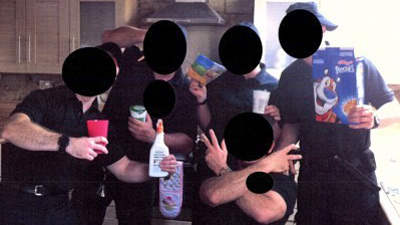
Five members of an elite police gun crime unit have been sacked for "inappropriate behaviour".


The photo was discovered during a professional standards investigation
An investigation into their conduct led to the discovery of a photograph which appeared to show the officers fooling around during a raid on a suspect's home.
The group were dismissed after being found guilty of gross misconduct.
All five constables worked within Merseyside Police's Matrix team which targets drug-related gang and gun crime in the region.
A sergeant who was part of the unit was fired in May as a result of the inquiry.
The sergeant and two constables are currently on police bail amid allegations that items removed during police searches appeared on eBay.
Deputy Chief Constable Bernard Lawson said: "We expect the highest standards from our officers and these officers fell far short of that expectation.
"As a force we believe it is important to take swift and decisive action when officers are found to have fallen short of the standards we expect and in this case we have done just that."
The Matrix unit helped target the gangs associated with the murder of schoolboy Rhys Jones who was shot dead in Croxteth in August 2007